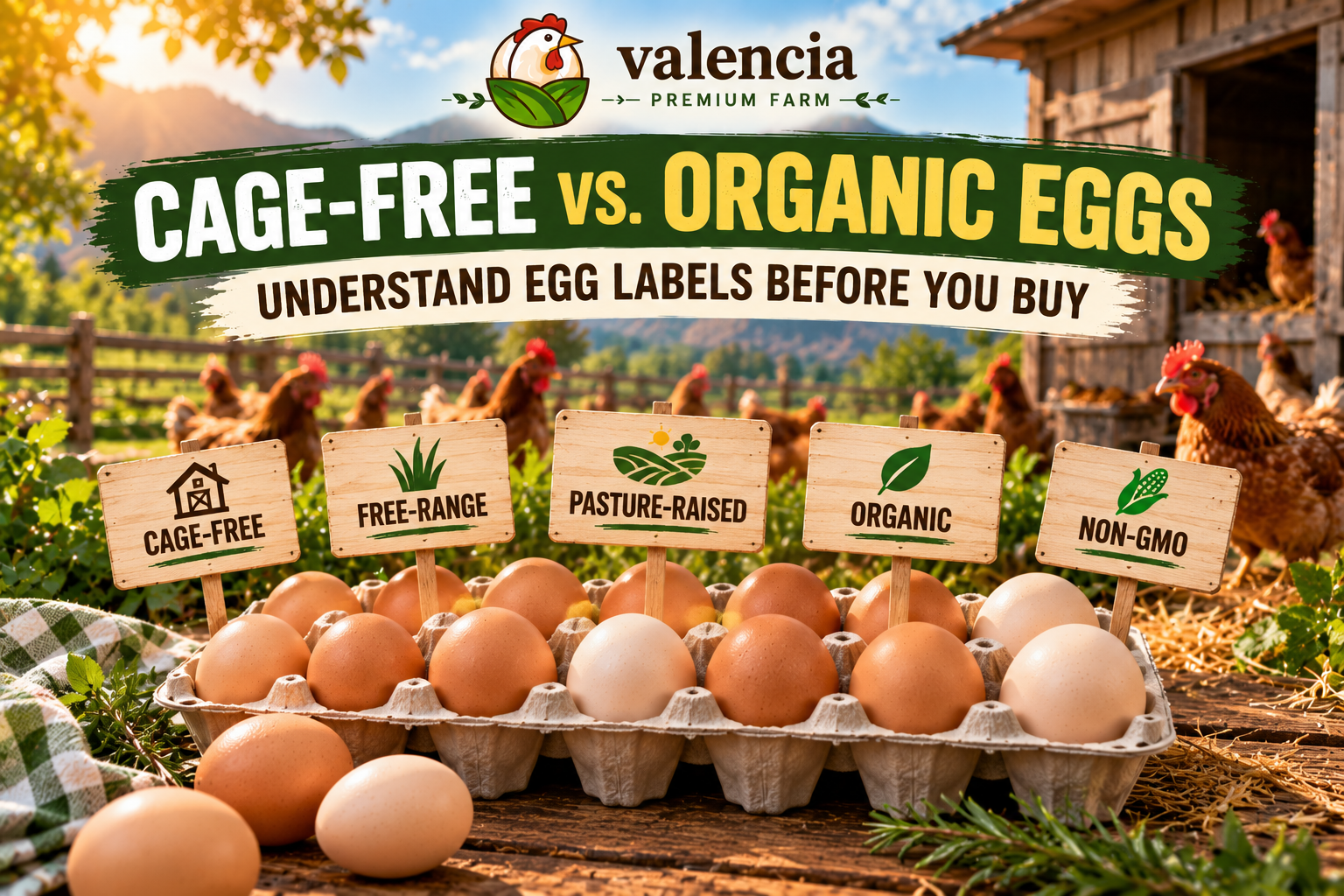
When shopping for eggs, you’ve probably noticed that cartons carry a wide variety of labels.
Some say cage-free. Others say free-range, pasture-raised, organic, or non-GMO.
These terms sound similar, but they don’t all mean the same thing.
Some describe how hens are housed. Others refer to what the birds eat, whether they have outdoor access, or whether the producer follows a particular certification program.
For consumers in Los Angeles, Santa Clarita Valley, and throughout California, understanding these differences can make buying eggs much easier.
One of the most common questions is: What’s the difference between cage-free vs. organic eggs?
The answer is simpler than you might think.
Cage-free describes a housing system in which hens aren’t kept in cages. Organic describes a broader set of production standards that includes feed requirements, animal care practices, and outdoor access.
But there’s much more to understand.
In this guide, we’ll explain the most common egg labels, what they guarantee, what they don’t guarantee, and how to choose eggs that match your preferences.
We’ll also introduce Valencia Premium Farm, a local farm in Acton, California, offering farm-fresh eggs from cage-free hens fed non-GMO feed.
Why Do Egg Cartons Have So Many Different Labels?
Egg labels help communicate information about the way eggs are produced.
However, not every label describes the same part of the production process.
For example, a carton might include:
- A housing claim, such as cage-free.
- An outdoor-access claim, such as free-range.
- A production certification, such as USDA Organic.
- A feed-related claim, such as non-GMO feed.
- A quality grade, such as USDA Grade A.
- An egg-size designation, such as Large.
A single carton may display several of these terms because they describe different characteristics.
Understanding which claims relate to housing, feeding, certification, and egg quality helps shoppers avoid common misconceptions.
1. What Does Cage-Free Mean?
Cage-free eggs come from hens that are not housed in cages.
Under USDA standards for eggs bearing the USDA grademark, cage-free hens must be able to move vertically and horizontally within indoor housing and have access to food and water.
These housing systems may include nesting areas, perches, litter, and other features that support natural behaviors.
Do Cage-Free Chickens Go Outside?
Not necessarily.
This is one of the biggest misunderstandings about cage-free eggs.
A cage-free hen may live inside a barn or poultry house without routine outdoor access.
The term tells you that the birds are not confined in cages. It does not, by itself, promise access to open fields or pasture.
Does Cage-Free Mean Organic?
No.
Cage-free and organic refer to different requirements.
A farm may raise cage-free hens without using certified organic feed.
Likewise, a producer must meet additional requirements before making a qualifying organic claim.
What Cage-Free Does Tell You
The term is useful when your purchasing priority is avoiding conventional cage housing.
However, cage-free alone does not establish:
- Organic certification.
- Outdoor access.
- Pasture access.
- Non-GMO feeding.
- A particular nutritional advantage.
For additional assurance about animal care, shoppers can look for credible third-party welfare certifications.
2. What Does Free-Range Mean?
Free-range eggs come from hens raised in a system that includes access to the outdoors.
For USDA-graded shell eggs labeled free-range, the production requirements include indoor freedom of movement and outdoor access.
This makes free-range different from cage-free.
Cage-Free vs. Free-Range Eggs
The main distinction is outdoor access.
Cage-free hens aren’t kept in cages, but outdoor access isn’t required.
Free-range hens have access to an outdoor area.
However, the amount of space, quality of the outdoor environment, and how much time individual hens actually spend outside can vary.
Does Free-Range Mean Pasture-Raised?
No.
An outdoor area isn’t necessarily a grassy pasture.
Some free-range systems provide outdoor yards or other designated areas rather than extensive vegetation.
If pasture access matters to you, ask the producer about the outdoor environment and look for additional verification.
3. What Does Pasture-Raised Mean?
Pasture-raised generally describes a production system in which hens have access to pasture areas where they can move and forage.
These areas may include vegetation, soil, insects, and other features of an outdoor environment.
However, pasture-raised does not have one universal federal definition for all egg-carton claims.
Specific requirements can depend on the certification program or standards used to support the claim.
What Should You Look For?
If you’re interested in pasture-raised eggs, consider asking:
- How much outdoor space is available?
- Do hens have access to vegetation?
- Is the outdoor area maintained or rotated?
- How is access managed during severe weather?
- Is the claim independently verified?
A third-party certification may provide more specific information about space requirements and animal care standards.
Are Pasture-Raised Eggs Always Organic?
No.
Pasture-raised and organic describe different aspects of production.
A pasture-based farm may use feed that isn’t certified organic.
An organic farm may provide compliant outdoor access without operating a traditional pasture-based system.
Some farms meet both sets of criteria, but one term doesn’t automatically establish the other.
4. What Are Organic Eggs?
Organic eggs are produced under the USDA National Organic Program’s requirements.
These standards cover more than housing.
They address organic feed, animal health practices, living conditions, outdoor access, and the use of prohibited substances.
Organic Feed Requirements
Organic poultry must receive feed that meets USDA organic requirements.
Organic production prohibits excluded methods, including genetic engineering, and restricts the use of prohibited substances.
Outdoor Access
Organic poultry must have access to the outdoors under the applicable regulations, subject to permitted temporary confinement for specific circumstances.
This doesn’t necessarily mean that organic hens spend all day roaming on open pasture.
Certification
Most producers making USDA organic claims must be certified by an accredited certifying agent.
Certain small operations qualify for a certification exemption, but they must still comply with applicable organic production and handling rules and cannot use the USDA Organic seal.
Does Organic Mean Cage-Free?
Organic poultry housing standards are incompatible with conventional cage confinement.
However, organic certification includes requirements beyond those covered by a cage-free claim.
The important distinction: Cage-free primarily addresses housing, while organic addresses a broader production system.
5. What Does Non-GMO Feed Mean?
You may also see eggs advertised as coming from hens fed non-GMO feed.
GMO stands for genetically modified organism.
A non-GMO feed claim refers to the feed provided to the hens and whether its ingredients meet the producer’s stated non-GMO standard.
Does Non-GMO Mean Organic?
No.
Non-GMO and organic are not interchangeable.
Organic feed must comply with USDA organic production rules, which prohibit genetic engineering.
Non-GMO feed, however, isn’t necessarily certified organic.
A feed can be non-GMO without meeting every organic production requirement.
Does Non-GMO Tell You How Hens Are Housed?
No.
A non-GMO feed claim doesn’t establish whether hens are cage-free, free-range, or pasture-raised.
Housing and feed are separate characteristics.
Valencia Premium Farm’s Approach
At Valencia Premium Farm, our eggs come from cage-free hens fed non-GMO feed.
These are the farming practices we communicate to customers.
We don’t describe our eggs as USDA Certified Organic or pasture-raised without verification of those additional claims.
6. Cage-Free vs. Free-Range vs. Pasture-Raised vs. Organic: Comparison Chart
Here’s a practical overview of the main differences.
| Egg Label | What It Primarily Describes | Outdoor Access | Organic Feed Required? |
|---|---|---|---|
| Cage-Free | Housing without cages | Not required by the label | No |
| Free-Range | Housing with outdoor access | Yes | No |
| Pasture-Raised | Access to pasture under the claimed standard | Generally yes | No |
| USDA Organic | Certified production practices, feed, and animal care | Required under organic rules | Yes |
| Non-GMO Feed | Feed ingredients | Not established by the claim | No |
Note: Specific claim-verification and animal-welfare requirements may differ between programs. Check the applicable label or certification for details.
Which Label Is Best?
There isn’t one universal answer.
If avoiding cages is your priority, cage-free may address that concern.
If outdoor access matters, look into free-range or pasture-raised claims.
If you’re seeking a regulated production system that includes organic feed requirements, USDA Organic may be more relevant.
If you’re interested specifically in feed ingredients, ask about non-GMO feed practices and verification.
The best choice depends on what you value most.
7. Are Organic Eggs Healthier Than Cage-Free Eggs?
It’s understandable to wonder whether certain egg labels automatically mean better nutrition.
However, the relationship between farming systems and egg nutrition is more complicated than a label alone suggests.
The USDA states that it does not have definitive scientific data establishing a nutritional difference solely because hens are housed in cage-free or free-range systems rather than cages.
Egg nutrient composition can be influenced by factors such as feed, breed, and other production conditions.
What Nutrients Do Eggs Provide?
Eggs are a source of:
- Protein.
- Choline.
- Vitamin B12.
- Selenium.
- Other vitamins and minerals.
The precise nutrient content can vary.
Does Organic Automatically Mean More Protein?
No.
An organic label doesn’t guarantee that an egg contains more protein than a comparable conventional egg.
Are Brown Eggs Healthier Than White Eggs?
Not inherently.
Eggshell color is primarily associated with the hen’s genetics and breed.
Brown eggs aren’t automatically more nutritious than white eggs.
What About Darker Egg Yolks?
Yolk color is influenced significantly by the hen’s diet.
A darker yolk doesn’t, by itself, prove that an egg is organic, pasture-raised, or nutritionally superior.
When comparing nutrition, look at reliable nutrition information rather than relying on shell or yolk color alone.
8. What Does USDA Grade A Mean?
Another label that shoppers frequently encounter is USDA Grade A.
Unlike cage-free or organic, this is an egg-quality designation.
USDA grades evaluate characteristics such as shell condition and interior quality.
The common consumer grades include Grade AA, Grade A, and Grade B.
Grade AA
These eggs meet high quality standards, including specific interior characteristics.
Grade A
Grade A eggs also meet high quality standards and are commonly sold to consumers.
Grade B
Grade B eggs are more commonly used in food processing or baking applications.
Does Grade A Mean Organic?
No.
USDA quality grades and USDA Organic certification are separate systems.
An egg may be Grade A without being organic.
Similarly, a housing claim doesn’t determine an egg’s quality grade.
9. Understanding Egg Labels in California
California consumers may encounter both federal egg-labeling rules and state-specific requirements.
One important distinction is that California has animal-confinement requirements affecting certain eggs sold in the state.
These requirements are separate from USDA organic certification.
As a result, consumers shouldn’t assume that an egg sold in California is automatically organic or pasture-raised.
What Should California Shoppers Check?
Look for information about:
- Housing practices.
- Outdoor access.
- Feed claims.
- Organic certification, when applicable.
- Third-party animal-welfare certifications.
- Egg quality and size.
- Handling and refrigeration.
For a specific legal or certification question, consult the appropriate state or federal authority rather than relying on packaging imagery alone.
10. How to Read an Egg Carton in Five Steps
The next time you buy eggs, try this simple approach.
Step 1: Identify the Housing Claim
Look for cage-free, free-range, or pasture-raised.
Ask what the term establishes about the hens’ environment.
Step 2: Check for Organic Certification
If organic production matters to you, look for qualifying organic labeling and certification information.
Remember that a small exempt organic operation may not use the USDA Organic seal.
Step 3: Examine Feed Claims
Terms such as non-GMO feed refer to what the hens eat.
Don’t confuse them with housing or certification claims.
Step 4: Look for Independent Verification
Some animal-welfare labels are supported by third-party standards and inspections.
Check which organization administers the certification and what it verifies.
Step 5: Compare Price, Quantity, and Convenience
Consider the cost per egg, packaging quantity, storage requirements, and whether the seller offers convenient pickup or delivery.
An informed purchase balances your preferences with your household’s practical needs.
11. Does Buying Farm-Fresh Eggs Mean They’re Organic?
No.
The phrase farm-fresh does not establish organic certification.
Eggs sold directly by a local farm can come from different housing and feeding systems.
Some farms are certified organic, while others follow different practices.
The most reliable approach is to ask specific questions.
Questions to Ask a Local Egg Farm
- Are the hens cage-free?
- Do they have outdoor access?
- What type of feed do they receive?
- Is the farm certified organic?
- Are animal-welfare claims independently verified?
- How are eggs handled and stored?
- What purchasing quantities are available?
These questions provide more useful information than relying on general marketing descriptions.
12. Where to Buy Cage-Free Eggs in Santa Clarita Valley
If you’re searching for cage-free eggs Santa Clarita, Valencia Premium Farm offers a local option.
Our farm is located in Acton, California, and provides eggs from cage-free hens fed non-GMO feed.
We offer two purchasing quantities:
| Product | Quantity | Price |
|---|---|---|
| Farm-Fresh Eggs | 12 eggs | $7 |
| Farm-Fresh Egg Tray | 30 eggs | $15 |
Customers can contact our team to ask about availability, farm pickup, and local delivery.
Local Egg Delivery
Valencia Premium Farm offers local delivery service in Santa Clarita Valley.
Delivery coverage and applicable conditions should be confirmed using your address or ZIP code.
Farm Pickup
Pickup can be coordinated at our farm in Acton.
Valencia Premium Farm
34717 Red Rover Mine Rd
Acton, CA 93510
Please contact our team before visiting.
Contact
Call, Text & WhatsApp: (661) 627-7030
Website: www.valenciapremiumfarm.com
13. Common Myths About Egg Labels
Misunderstandings about egg labels can make shopping more confusing than necessary.
Let’s clarify several common myths.
Myth 1: Cage-Free Means Chickens Live Outdoors
Fact: Cage-free hens aren’t housed in cages, but outdoor access isn’t required by the claim.
Myth 2: Free-Range and Pasture-Raised Mean Exactly the Same Thing
Fact: Both relate to outdoor access, but pasture-raised generally refers to pasture environments. Specific standards and verification may differ.
Myth 3: Non-GMO Eggs Are Automatically Organic
Fact: Non-GMO feed and organic certification are different claims.
Myth 4: Brown Eggs Are More Nutritious
Fact: Shell color alone doesn’t establish a nutritional advantage.
Myth 5: Organic Eggs Always Come from Hens Roaming Large Pastures
Fact: Organic standards require outdoor access, but that doesn’t automatically mean a traditional pasture-based system.
Myth 6: Farm-Fresh Means Certified Organic
Fact: Farm-fresh isn’t a substitute for organic certification.
Myth 7: Cage-Free Eggs Always Contain More Nutrients
Fact: Cage-free housing alone doesn’t establish superior nutritional content.
Frequently Asked Questions About Cage-Free and Organic Eggs
What is the main difference between cage-free and organic eggs?
Cage-free describes a housing system without cages. Organic refers to a broader regulated production system involving feed, living conditions, animal care, and certification requirements.
Are cage-free eggs organic?
Not necessarily. Cage-free eggs can come from hens that aren’t fed certified organic feed.
Are organic eggs cage-free?
Organic poultry standards don’t permit conventional cage confinement and require appropriate living conditions and outdoor access.
Do cage-free hens go outside?
Not necessarily. Outdoor access isn’t required for a cage-free claim.
What’s the difference between free-range and pasture-raised eggs?
Free-range involves outdoor access. Pasture-raised generally refers to access to pasture, although the precise standards depend on the program or claim.
Are pasture-raised eggs always organic?
No. A pasture-raised producer may use nonorganic feed or lack organic certification.
Does non-GMO feed mean the eggs are organic?
No. Non-GMO feed does not automatically meet all USDA organic requirements.
Are brown eggs healthier than white eggs?
Shell color alone doesn’t indicate a nutritional difference.
Does USDA Grade A mean cage-free?
No. USDA Grade A refers to egg quality, not the housing system.
Does Valencia Premium Farm sell cage-free eggs?
Yes. Valencia Premium Farm offers eggs from cage-free hens fed non-GMO feed.
Are Valencia Premium Farm eggs USDA Certified Organic?
We don’t advertise our eggs as USDA Certified Organic. Customers can contact the farm for information about its stated farming practices.
Where can I buy cage-free eggs near Santa Clarita?
Valencia Premium Farm offers cage-free eggs from its farm in Acton, California. Contact the team for availability, pickup, and local delivery information.
Choose Eggs with Confidence
Understanding egg labels helps you make decisions based on meaningful information rather than confusing terminology.
Cage-free, free-range, pasture-raised, organic, and non-GMO don’t all describe the same thing.
Some refer to housing. Others concern outdoor access, feed, or broader production standards.
By learning the differences, you can choose eggs that match your priorities and ask more informed questions when buying from local farms.
At Valencia Premium Farm, we believe customers should know what they’re purchasing.
That’s why we clearly communicate that our eggs come from cage-free hens fed non-GMO feed.
Looking for Farm-Fresh Eggs in Santa Clarita Valley?
Valencia Premium Farm
12 Eggs — $7
30 Eggs — $15
Farm Pickup:
34717 Red Rover Mine Rd, Acton, CA 93510
Local Delivery:
Available in Santa Clarita Valley, subject to address and service confirmation.
Call, Text & WhatsApp:
(661) 627-7030
Website:
www.valenciapremiumfarm.com
Contact us to order farm-fresh eggs or ask about our farming practices.
Valencia Premium Farm — Farm Fresh. Local. Delicious.