
Farm-fresh eggs are known for their freshness, quality, and direct connection to the farm where they were produced. But once you bring a carton home, an important question comes up:
How long do farm fresh eggs last?
The answer depends largely on how the eggs are handled, whether they have been washed, how they are stored, and whether they remain consistently refrigerated.
For customers purchasing local eggs in Acton, Santa Clarita, and surrounding areas of Southern California, proper storage is especially important. California requires shell eggs to be refrigerated, and keeping them at a safe, consistent temperature helps maintain both quality and food safety.
In this guide, we’ll explain how long farm-fresh eggs can last, the best way to store them, how to recognize signs of spoilage, and what you can do to preserve their freshness after bringing them home.
How Long Do Farm Fresh Eggs Last?
There isn’t one universal expiration date for every farm-fresh egg.
Several factors influence shelf life, including:
- When the egg was laid
- Whether it was washed
- How it was handled
- Storage temperature
- Whether refrigeration remained consistent
- Shell condition
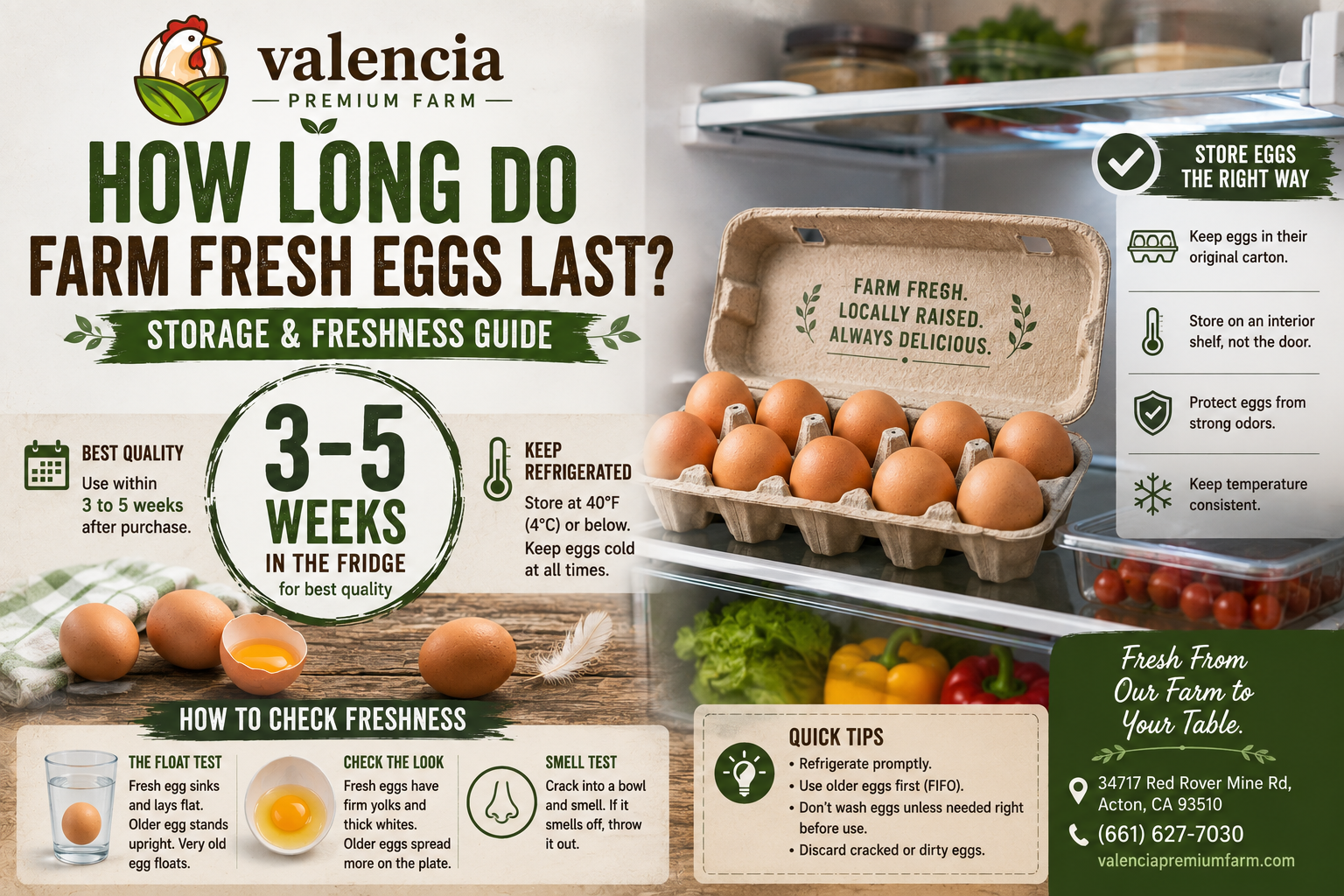
For refrigerated eggs in the United States, a useful general rule is to use them within 3 to 5 weeks after purchase, provided they have been properly refrigerated and handled.
That doesn’t mean an egg suddenly becomes spoiled on a particular day.
Instead, egg quality gradually changes over time.
The fresher the egg, the better its characteristics tend to be for preparations where texture and appearance matter.
That’s one reason buying eggs from a local producer can be appealing: a shorter journey between farm and customer can mean you’re starting with a fresher product.
Why Farm-Fresh Eggs Can Be Different
The term farm fresh eggs usually refers to eggs purchased directly from a farm or local producer rather than through a long commercial distribution chain.
That distinction matters.
A conventional grocery-store egg may pass through several stages before reaching your refrigerator:
Farm → processing → distribution center → transportation → retailer → customer
When purchasing directly from a local farm, that chain can be considerably shorter.
For customers looking for farm fresh eggs near Santa Clarita or Acton, CA, buying locally also provides an opportunity to know where the eggs came from and ask the producer about handling and storage.
However, being farm fresh doesn’t make eggs immune to spoilage.
They still need to be handled correctly.
Should Farm Fresh Eggs Be Refrigerated?
In California, the practical answer is straightforward:
Yes. Keep your eggs refrigerated.
Once you receive refrigerated eggs, they should remain refrigerated.
Avoid repeatedly allowing refrigerated eggs to warm to room temperature and then placing them back into the refrigerator.
Consistent refrigeration helps protect both safety and quality.
A refrigerator temperature of approximately 40°F (4°C) or below is generally recommended for perishable foods such as eggs.
The refrigerator—not the kitchen counter—is therefore the appropriate place to store commercially handled or refrigerated shell eggs.
Where Should You Store Eggs in the Refrigerator?
Many refrigerators have a convenient egg tray built directly into the door.
It looks like the obvious place to put them.
But it isn’t necessarily the best location.
The refrigerator door experiences greater temperature fluctuations because it’s repeatedly opened and exposed to warmer room air.
Instead, keep your eggs:
Inside their original carton and on an interior refrigerator shelf.
This provides a more stable temperature.
The carton also offers physical protection against cracking and helps reduce exposure to odors from other foods.
A simple storage routine can therefore make a meaningful difference:
Keep them cold. Keep them protected. Keep them in their carton.
Why Should Eggs Stay in Their Original Carton?
There’s a temptation to transfer eggs into decorative refrigerator organizers.
They look clean and attractive.
But the original carton serves several useful purposes.
It Protects the Shells
Eggshells can crack when they bump against other foods or hard refrigerator surfaces.
The carton provides cushioning and separation.
It Helps Reduce Odor Exposure
Eggshells are porous. Keeping eggs inside their carton provides additional protection from strong odors in the refrigerator.
It Helps You Track the Eggs
Packaging may contain useful information related to handling, dates, or the producer.
Keeping the carton makes it easier to remember which eggs you purchased and when.
Washed vs. Unwashed Farm Fresh Eggs
If you’ve researched farm-fresh eggs online, you’ve probably encountered discussions about washed vs. unwashed eggs.
Freshly laid eggs naturally have a protective coating commonly called the bloom or cuticle.
This coating helps protect the shell.
Washing removes or alters that natural protective layer, which is one reason refrigeration becomes especially important after eggs are washed.
Practices surrounding egg washing vary internationally.
In the United States, commercial egg handling commonly involves washing and refrigeration, whereas some other countries use different production and storage systems.
For consumers, the safest approach is simple:
Follow the storage instructions provided with the eggs and keep refrigerated eggs refrigerated.
Don’t assume that advice you see online about backyard eggs in another country applies to eggs purchased in California.
How Can You Tell If an Egg Is Fresh?
Egg freshness changes gradually.
As an egg ages, several physical characteristics change inside the shell.
When you crack a very fresh egg onto a flat surface, you may notice:
- A relatively firm, rounded yolk
- Thick egg white surrounding the yolk
- Less spreading across the surface
As eggs age, the white tends to become thinner and spread farther.
The yolk may also appear flatter.
These changes don’t automatically mean an older egg is spoiled.
They often indicate changes in quality associated with age.
What About the Egg Float Test?
One of the most popular online methods for testing egg freshness is the float test.
The method involves placing an egg into a container of water.
People commonly interpret the results as:
Egg sinks and lies flat: fresher egg.
Egg stands upright: older egg.
Egg floats: considerably older egg.
Why does this happen?
Eggs contain an internal air cell.
As an egg ages, moisture and gases gradually move through the porous shell, causing the air cell to become larger. Increased air inside the egg makes it more buoyant.
However, there’s an important distinction:
The float test estimates age—not food safety.
An egg floating does not provide a definitive microbiological test for whether it is safe or unsafe to eat.
Likewise, an egg sinking does not guarantee that it is safe.
The float test can therefore be interesting for estimating relative freshness, but it shouldn’t replace proper storage, handling, and examination of the egg.
How to Tell If an Egg Has Gone Bad
When in doubt, don’t rely on a single trick.
Instead, evaluate the egg carefully.
Check the Shell
Avoid using eggs with badly cracked, leaking, or otherwise compromised shells.
Cracks can provide an opportunity for contamination.
Crack It Into a Separate Bowl
Rather than cracking a questionable egg directly into your recipe, open it into a clean separate bowl.
This allows you to inspect it without ruining the rest of your ingredients.
Smell the Egg
A spoiled egg generally produces a strong, unmistakably unpleasant odor.
If an egg smells wrong, discard it.
Look for Unusual Appearance
If you notice clearly abnormal discoloration or other signs of spoilage, don’t use the egg.
When food safety is uncertain, discarding the product is preferable to taking an unnecessary risk.
Does Eggshell Color Affect Shelf Life?
No.
Brown, white, blue, cream, and other naturally occurring shell colors primarily result from the breed of chicken.
Shell color alone does not determine:
- Freshness
- Shelf life
- Nutritional quality
- Cage-free status
- Food safety
A brown egg doesn’t automatically last longer than a white egg.
Proper handling and refrigeration are far more important.
Can You Freeze Farm Fresh Eggs?
Yes—but don’t freeze raw eggs in their shells.
The liquid inside can expand as it freezes, potentially cracking the shell.
Instead, if you need to preserve eggs longer, remove them from their shells first.
Whole eggs can be cracked into a clean container and gently mixed before freezing.
Egg whites can also be frozen separately.
Freezing can be useful when you have more eggs than you’ll realistically consume before their refrigerated quality begins to decline.
Frozen eggs are often especially useful later for:
- Baking
- Scrambled eggs
- Casseroles
- Cooking
Always use appropriate freezer-safe containers and follow established food-safety guidance for freezing and thawing eggs.
How Long Do Hard-Boiled Eggs Last?
Cooking eggs changes their storage timeline.
Hard-boiled eggs should be refrigerated promptly after preparation and generally used within about one week when properly refrigerated.
This applies whether the eggs are peeled or still in their shells.
If you prepare eggs in advance for breakfasts, lunches, or meal prep, label the storage container with the preparation date.
That makes it easier to keep track.
How Long Do Cooked Egg Dishes Last?
Egg-based dishes have different storage requirements than raw shell eggs.
Foods such as:
- Quiche
- Breakfast casseroles
- Scrambled eggs
- Frittatas
- Egg sandwiches
should be refrigerated promptly rather than left sitting at room temperature for extended periods.
Their safe refrigerated storage time is typically much shorter than that of raw shell eggs.
When storing prepared foods, always follow appropriate food-safety guidance for leftovers.
Farm Fresh Eggs vs. Grocery Store Eggs: Which Stay Fresh Longer?
This question doesn’t have a simple universal answer.
A farm-fresh egg doesn’t automatically have a different biological shelf life simply because it came from a small farm.
What can differ is how old the egg is when you purchase it.
Consider two eggs stored under equivalent conditions.
One reaches the consumer shortly after being produced.
The other spends additional time moving through processing, distribution, transportation, warehousing, and retail.
Naturally, the first egg begins its time in your refrigerator at an earlier point in its life.
That’s one of the biggest potential advantages of purchasing eggs locally:
You’re shortening the distance between the farm and your kitchen.
Why Freshness Matters When Cooking
Freshness isn’t only about how long an egg can remain refrigerated.
It can also affect cooking characteristics.
Very fresh eggs often have firmer whites and yolks that maintain their shape well.
This can make them particularly appealing for preparations such as:
Fried Eggs
A firmer white tends to stay closer to the yolk rather than spreading widely across the pan.
Poached Eggs
Fresh eggs can produce a more compact shape during poaching.
Sunny-Side-Up Eggs
A rounded yolk and firm white can create the classic appearance many people want.
Breakfast Plates
When the egg itself is the centerpiece of the dish, freshness becomes especially noticeable.
Older—but still properly stored and safe—eggs can still be useful for many recipes, particularly when appearance isn’t important.
How to Keep Farm Fresh Eggs Fresh Longer
The good news is that preserving egg quality doesn’t require complicated equipment.
Follow a few basic practices:
1. Refrigerate eggs promptly.
Don’t leave refrigerated eggs sitting unnecessarily at room temperature.
2. Keep your refrigerator at 40°F (4°C) or below.
Stable refrigeration is important.
3. Store eggs inside the refrigerator rather than in the door.
Interior shelves generally provide more consistent temperatures.
4. Keep eggs in their carton.
The carton protects the shells and helps minimize exposure.
5. Avoid cracked eggs.
Discard eggs with compromised shells when appropriate.
6. Practice first-in, first-out storage.
If you purchase another carton, use the older eggs first.
These simple habits can help maintain freshness and reduce unnecessary food waste.
Buying Farm Fresh Eggs in Acton, California
For residents looking for farm fresh eggs in Acton, CA, buying directly from a local producer offers an opportunity to shorten the distance between where eggs are produced and where they’re eaten.
Valencia Premium Farm is located in Acton, California.
Our focus is straightforward:
Fresh eggs, locally raised hens, and a direct connection between our farm and your table.
📍 Valencia Premium Farm
34717 Red Rover Mine Rd
Acton, CA 93510
📞 (661) 627-7030
For customers in Acton, Santa Clarita, and surrounding communities, purchasing locally also means knowing exactly where your eggs come from.
Farm Fresh Eggs Near Santa Clarita, CA
People searching for:
“farm fresh eggs near me”
“fresh eggs Santa Clarita”
“local eggs Santa Clarita CA”
“cage-free eggs near Santa Clarita”
or
“farm fresh eggs Acton CA”
may be surprised to discover local agricultural producers just outside the more developed areas of the Santa Clarita Valley.
Acton provides a connection between Southern California communities and the farms producing food locally.
Choosing local eggs can therefore provide both freshness and transparency.
Instead of purchasing a product from an unknown supply chain, you know the farm behind your food.
Frequently Asked Questions About Farm Fresh Egg Storage
How long do farm fresh eggs last in the refrigerator?
Properly refrigerated eggs can generally maintain quality for several weeks. A common guideline for refrigerated shell eggs is approximately 3 to 5 weeks after purchase, assuming proper handling and refrigeration.
Should farm fresh eggs be refrigerated?
For eggs sold and handled under California’s refrigerated system, yes. Keep them consistently refrigerated.
What temperature should eggs be stored at?
Keep your refrigerator at approximately 40°F (4°C) or below.
Should I store eggs in the refrigerator door?
An interior shelf is generally preferable because the temperature tends to remain more stable than in the refrigerator door.
Can I wash farm fresh eggs at home?
If you’ve purchased eggs from a producer, follow the handling and storage guidance provided with them. Avoid unnecessary washing immediately before long-term storage unless appropriate for the type of eggs you have.
How do I know when an egg has gone bad?
Check for damaged shells and unusual appearance, and crack questionable eggs into a separate bowl. A strong unpleasant odor is a clear reason to discard an egg.
Does the float test tell me whether an egg is safe?
No. It primarily provides information related to the egg’s age and air cell. It should not be considered a definitive food-safety test.
Can farm fresh eggs be frozen?
Egg contents can be frozen using appropriate methods, but raw eggs should not be frozen inside their shells.
The Bottom Line: Fresh Eggs Start With Proper Storage
So, how long do farm fresh eggs last?
With appropriate refrigeration and handling, eggs can remain usable for several weeks. But maximizing freshness begins the moment you bring them home.
Keep them refrigerated.
Keep them in their carton.
Store them on an interior refrigerator shelf.
Protect them from cracks and unnecessary temperature changes.
And when possible, start with eggs that haven’t traveled through a lengthy supply chain before reaching your kitchen.
For customers in Acton, Santa Clarita, and nearby Southern California communities, purchasing from a local farm offers something beyond convenience:
You know where your food comes from.
At Valencia Premium Farm, that’s exactly what farm to table means.
Farm fresh · Locally raised · Always delicious.