Eggs are a staple in many American households. From scrambled eggs in the morning to homemade baked goods, meal prep, and family dinners, they are one of the most versatile ingredients you can keep in your refrigerator.
But if your household goes through eggs quickly, you may have wondered: Is buying eggs in bulk actually worth it?
Instead of purchasing a dozen eggs every few days, buying a 30-count egg flat could help you save money, reduce shopping trips, and keep a convenient supply available for everyday cooking.
However, buying more eggs at once is not always the best choice for every household.
The real value depends on how frequently you eat eggs, how much refrigerator space you have, how you store them, and whether you can use them before their quality declines.
For families in Santa Clarita Valley and Acton, California, purchasing eggs directly from a local farm can provide another option worth considering.
In this guide, we’ll explore the advantages of buying eggs in bulk, compare the costs of a dozen eggs versus a 30-count flat, explain safe storage practices, and help you decide which option makes the most sense for your household.
What Does Buying Eggs in Bulk Mean?
Buying eggs in bulk generally means purchasing a larger quantity than a standard dozen.
While grocery stores commonly sell eggs in cartons of 12 or 18, some retailers and farms offer larger packages containing 30 or more eggs.
A popular option is the 30-count egg flat.
What Is a 30-Count Egg Flat?
A 30-count egg flat is a tray designed to hold 30 individual eggs.
These trays typically have five rows of six eggs, although packaging arrangements may vary.
Egg flats are commonly used by farms, food-service businesses, restaurants, bakeries, and households that consume eggs regularly.
Unlike a traditional egg carton, some flats may not have a protective lid. This makes careful transportation and storage particularly important.
Who Usually Buys 30 Eggs at Once?
A 30-count egg flat may be useful for:
- Large families preparing breakfast daily.
- Households that frequently bake.
- People who prepare meals in advance.
- Home cooks who use eggs in multiple recipes.
- Customers purchasing eggs for gatherings.
- Small food businesses with regular egg consumption.
You do not necessarily need a large family to benefit from buying 30 eggs.
Even a household of two people may find the larger quantity practical if eggs are part of its daily routine.
The key is knowing how quickly you will use them.
Is Buying Eggs in Bulk Cheaper?
One of the biggest reasons people consider buying eggs in bulk is the potential to save money.
However, purchasing a larger quantity does not automatically guarantee a lower price.
To determine whether a bulk purchase is worthwhile, compare the price per egg rather than focusing only on the total package price.
Comparing 12 Eggs vs. 30 Eggs
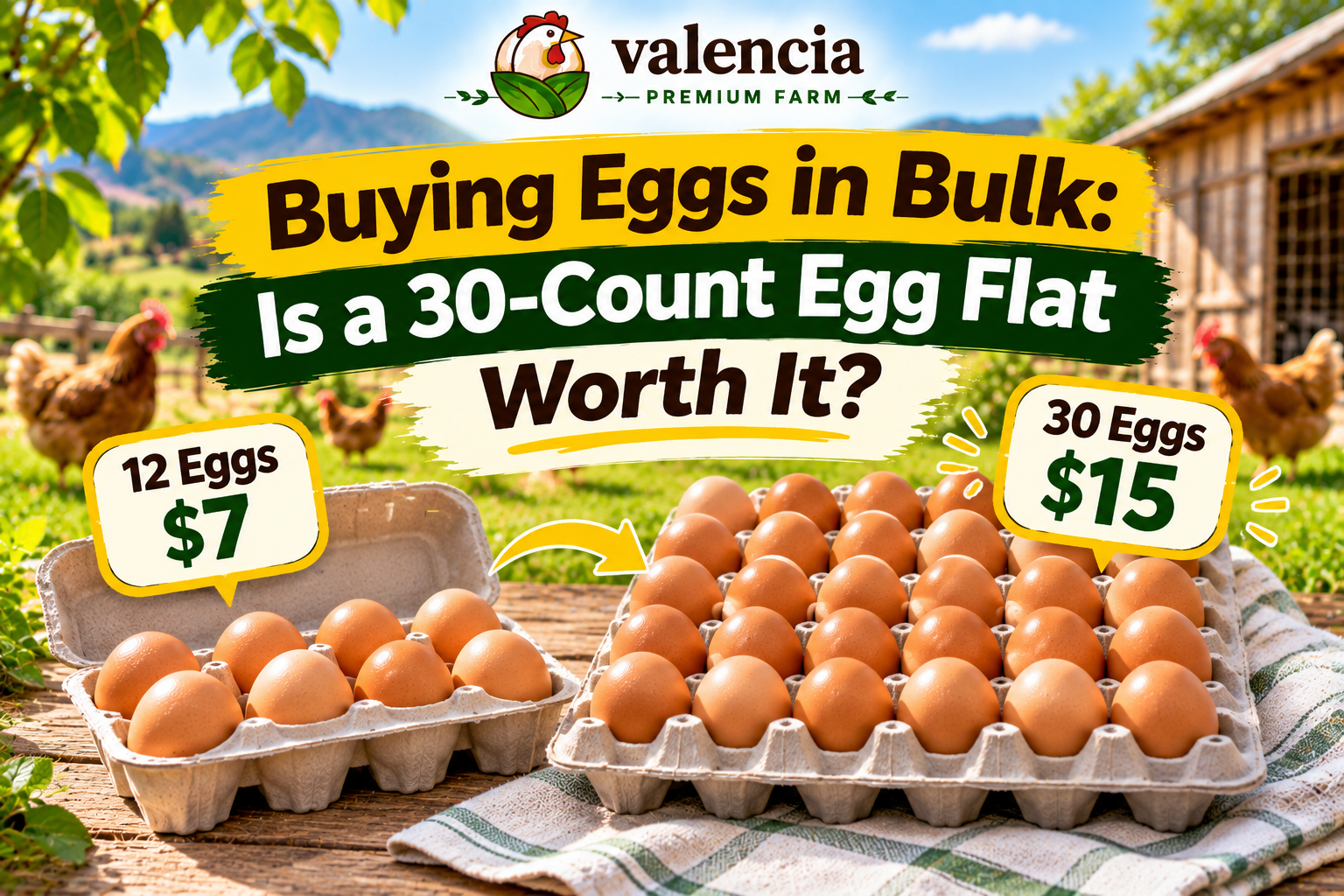
At Valencia Premium Farm in Acton, California, our current egg options include:
| Egg Quantity | Total Price | Price Per Egg |
|---|---|---|
| 12 eggs | $7.00 | Approximately $0.58 |
| 30 eggs | $15.00 | $0.50 |
A dozen eggs at $7 costs approximately $0.583 per egg.
A 30-count egg flat at $15 costs exactly $0.50 per egg.
That means the 30-count option offers a lower cost per egg.
How Much Can You Save?
Let’s compare the cost of purchasing 30 eggs at the standard dozen price.
At $7 per dozen, 30 eggs would cost the equivalent of $17.50.
With the 30-count flat priced at $15, the difference is:
$17.50 − $15.00 = $2.50
That represents approximately 14.3% savings per egg compared with the dozen price.
These calculations are based on Valencia Premium Farm’s listed egg prices and do not include any additional purchasing costs that might apply.
Do Small Savings Really Matter?
Saving $2.50 on a single purchase might not seem significant.
However, households that purchase eggs frequently may appreciate the difference over time.
For example, if you purchase a 30-count flat twice per month, the savings compared with the equivalent dozen-unit price would total approximately $5 monthly.
Over 12 months, that represents approximately $60 in potential savings.
Actual savings depend on purchasing frequency, prices, and whether all the eggs are used.
Five Benefits of Buying Eggs in Bulk
Bulk egg purchases can provide advantages beyond a lower price per egg.
1. Lower Cost Per Egg
When a larger package offers a genuine unit-price discount, customers can reduce the average cost of each egg.
This can be especially useful for families that regularly prepare egg-based meals.
2. Fewer Shopping Trips
Running out of eggs can be inconvenient when you are preparing breakfast or following a recipe.
Keeping a larger supply in the refrigerator may reduce how often you need to shop for this particular ingredient.
For busy households, fewer last-minute purchases can make weekly meal planning easier.
3. Convenient Meal Preparation
Eggs can be incorporated into a wide variety of dishes.
Having 30 eggs available gives households flexibility when planning breakfasts, lunches, dinners, and baked goods.
4. Better Planning for Families
Families that consume eggs frequently can estimate their weekly needs and purchase accordingly.
For example, a family using four eggs per day would consume 28 eggs in one week.
A 30-count flat would closely match that household’s weekly usage.
5. More Flexibility for Baking
Many baking recipes require several eggs.
Cakes, muffins, cookies, pancakes, and homemade breads can quickly use a standard dozen.
Purchasing a larger quantity may be convenient for customers who bake regularly.
How Long Will 30 Eggs Last in Your Household?
Before purchasing eggs in bulk, consider how frequently your household uses them.
A simple calculation can help determine whether 30 eggs is an appropriate quantity.
Estimate Your Daily Egg Consumption
Start by calculating the average number of eggs your household consumes each day.
For example:
| Average Daily Use | Approximate Time to Use 30 Eggs |
|---|---|
| 1 egg | 30 days |
| 2 eggs | 15 days |
| 3 eggs | 10 days |
| 4 eggs | 7–8 days |
| 5 eggs | 6 days |
| 6 eggs | 5 days |
These estimates assume relatively consistent consumption.
Actual use may vary depending on your cooking habits.
Example: A Family of Four
Imagine a family of four that prepares breakfast with eggs several times per week.
If the family uses four eggs each morning for five days, it will consume 20 eggs.
The remaining 10 eggs could be used for baking, lunches, or additional breakfasts.
For this household, a 30-count flat could be a practical purchase.
Example: A Smaller Household
A couple that eats two eggs daily would use 30 eggs in approximately 15 days.
In that situation, buying 30 eggs may still make sense, provided they are stored correctly and used within an appropriate period.
When Buying a Dozen May Be Better
A smaller carton may be more practical if you:
- Eat eggs only occasionally.
- Have limited refrigerator space.
- Travel frequently.
- Prefer purchasing smaller quantities.
- Are uncertain how quickly you will use the eggs.
Buying in bulk only creates meaningful value when the additional quantity is useful.
How to Store a 30-Count Egg Flat Properly
Proper storage is one of the most important considerations when buying eggs in bulk.
Eggs are perishable foods and must be handled carefully.
Keep Eggs Refrigerated
According to USDA food-safety recommendations, shell eggs should be refrigerated promptly and stored at 40°F (4°C) or below.
Avoid leaving eggs on the kitchen counter for extended periods.
This is especially important during warm weather.
In Southern California, high outdoor temperatures can make transportation and storage particularly important.
Use Protective Packaging
A 30-count egg flat may not offer the same protection as a closed carton.
If your eggs arrive in an open tray, place them in a suitable covered food-safe container or transfer them carefully into clean egg cartons.
Protecting the eggs helps reduce the risk of breakage.
When possible, retain the original packaging information, including relevant dates and producer details.
Store Eggs Inside the Refrigerator
The refrigerator’s interior shelves generally provide more stable temperatures than the door.
Choose a location where eggs are unlikely to be knocked over or crushed.
Avoid placing heavy containers on top of an egg flat.
How Long Can Refrigerated Eggs Last?
USDA guidance indicates that raw shell eggs can generally be refrigerated for three to five weeks.
This is a general storage guideline, not a guarantee for every egg.
The actual usable period depends on factors such as prior handling, refrigeration, packaging dates, and product condition.
Follow applicable package dates and discard eggs that show signs of spoilage.
Should You Wash Farm-Fresh Eggs at Home?
Consumers should not assume that washing eggs at home makes them safer.
Egg washing and sanitation are subject to specific handling practices.
If you have questions about how farm eggs were cleaned or prepared for sale, ask the producer.
Avoid unnecessary handling that could damage the shell or introduce contamination.
Can You Freeze Eggs If You Buy Too Many?
Yes, eggs can be frozen, but raw eggs should not be frozen in their shells.
Freezing shell eggs can cause the contents to expand and crack the shell.
Instead, eggs should be removed from their shells and prepared appropriately for freezing.
How to Freeze Whole Eggs
For raw whole eggs:
- Crack the eggs into a clean bowl.
- Gently mix the yolks and whites together.
- Transfer the mixture into a suitable freezer-safe container.
- Label the container with the date and quantity.
- Freeze promptly.
USDA guidance generally recommends using frozen eggs within one year for best quality.
Can You Freeze Egg Whites?
Yes. Egg whites can be frozen separately in suitable containers.
This may be useful for customers who frequently prepare recipes requiring only egg whites.
What About Egg Yolks?
Raw egg yolks require additional preparation because they can become thick or gel-like during freezing.
Follow USDA guidance for freezing yolks intended for sweet or savory recipes.
For detailed instructions, consult the USDA’s official egg-storage recommendations.
Are Bulk Eggs as Fresh as Smaller Cartons?
Egg quantity does not determine freshness.
A 30-count flat can contain eggs that are just as fresh as those in a smaller carton, depending on collection, packing, handling, and storage.
Similarly, purchasing a dozen eggs does not automatically guarantee greater freshness.
What Should You Check Before Purchasing?
Consider asking:
- When were the eggs collected or packed?
- How have they been stored?
- Are the shells intact?
- What is the recommended storage procedure?
- Is there a date or label available for reference?
These questions are useful regardless of the package size.
Does Buying Directly from a Farm Make a Difference?
Buying directly from a local farm can provide an opportunity to communicate with the producer.
Customers may be able to ask about collection practices, handling, availability, and purchasing options.
However, local origin alone does not guarantee freshness or superior nutritional quality.
Proper handling and food safety remain essential.
Are Farm-Fresh Eggs Better for Bulk Purchases?
Buying directly from a farm can be appealing for households that prefer to support nearby agricultural businesses.
For customers in Santa Clarita Valley, a local producer may offer convenient purchasing quantities and opportunities to learn more about farming practices.
Know Where Your Eggs Come From
Purchasing from a local farm can help customers understand where their eggs are produced.
You can ask about the hens, their feed, and the farm’s handling practices.
Understand Farming Labels
Egg labels such as cage-free, free-range, pasture-raised, and organic describe different production characteristics.
They should not be treated as interchangeable.
For example, cage-free refers to a housing system in which hens are not kept in conventional cages.
It does not automatically establish outdoor access or organic certification.
Support Nearby Agriculture
Buying from a local farm supports agricultural businesses operating in or near your community.
For residents of Acton, Valencia, Newhall, Saugus, and Canyon Country, purchasing locally can also create a connection with nearby food producers.
For additional guidance, explore our article:
Buying Eggs Directly from a Local Farm: What You Need to Know.
Is a 30-Count Egg Flat Good for Meal Prep?
Eggs are useful for preparing meals ahead of time because they can be incorporated into many different recipes.
However, cooked egg dishes must also be stored and handled safely.
Breakfast Meal Preparation
A larger egg supply can help households prepare:
- Scrambled eggs
- Omelets
- Breakfast burritos
- Egg muffins
- Breakfast sandwiches
When preparing food in advance, refrigerate cooked egg dishes promptly.
High-Protein Meal Planning
Eggs are a convenient source of protein.
A typical large egg provides approximately six grams of protein.
Customers who regularly include eggs in their meals may find a 30-count flat useful.
However, nutritional needs vary, and egg consumption should be considered as part of an overall balanced diet.
Baking and Family Recipes
Eggs are also important ingredients in many baked foods.
They contribute structure, moisture, and other functional properties to recipes.
Keeping a larger quantity available may simplify meal preparation for frequent home bakers.
How Long Can Cooked Eggs Be Stored?
USDA guidance recommends refrigerating cooked egg dishes promptly and generally consuming them within three to four days.
Hard-boiled eggs can generally be refrigerated for up to one week.
These storage recommendations are important when preparing meals in advance.
When Is Buying Eggs in Bulk Not Worth It?
Although bulk purchases can offer savings, there are situations where buying fewer eggs makes more sense.
You Rarely Eat Eggs
If your household uses only one or two eggs per week, a 30-count flat may be more than you need.
Purchasing smaller quantities can help reduce food waste.
You Have Limited Refrigerator Space
Eggs need proper refrigeration.
If your refrigerator is already crowded, storing a large flat safely may be difficult.
You Cannot Use Them in Time
A lower price per egg is not beneficial if a substantial portion of the purchase goes unused.
Consider your typical consumption before choosing a larger quantity.
You Are Comparing Different Products
When comparing egg prices, make sure you are evaluating similar products.
Egg size, grade, farming practices, and purchasing conditions may differ.
The lowest price per egg is not necessarily the best overall option for every customer.
Buying 30 Eggs in Santa Clarita Valley
For customers looking to buy eggs in larger quantities near Santa Clarita Valley, Valencia Premium Farm offers a 30-count option.
Our farm is located in Acton, California, where we raise cage-free hens fed non-GMO feed.
We offer eggs for households that prefer purchasing directly from a local producer.
Valencia Premium Farm Egg Prices
Our available purchasing options include:
12 eggs — $7
Suitable for smaller households or customers who prefer a standard dozen.
30 eggs — $15
A convenient option for families, frequent home cooks, and customers who regularly use eggs.
At these listed prices, the 30-count option provides a lower cost per egg.
Farm Pickup in Acton
Customers can arrange to pick up their eggs directly from our farm in Acton.
Contact us before visiting to confirm product availability and pickup arrangements.
Local Delivery in Santa Clarita Valley
Valencia Premium Farm offers free local delivery in eligible Santa Clarita Valley areas.
Delivery coverage must be confirmed for the customer’s specific ZIP code or address.
Customers in Valencia, Saugus, Newhall, Canyon Country, and nearby communities can contact our team to inquire about service availability.
How to Order a 30-Count Egg Flat
Ordering is simple.
Contact our customer service representative through WhatsApp and provide:
- Your preferred egg quantity.
- Your ZIP code or delivery location.
- Whether you prefer delivery or farm pickup.
Our representative can confirm availability, delivery coverage, and the next steps for your order.
WhatsApp: +1 (661) 627-7030
Frequently Asked Questions About Buying Eggs in Bulk
Is buying eggs in bulk cheaper?
It can be. Bulk purchasing may lower the price per egg, but the savings depend on the seller’s pricing. At Valencia Premium Farm, the 30-count flat offers a lower unit price than the 12-count option.
How much does a 30-count egg flat cost?
Prices vary by farm, retailer, location, and egg type. At Valencia Premium Farm, a 30-count egg flat is priced at $15.
How many dozens are in 30 eggs?
Thirty eggs equal two and a half dozen.
How long will 30 eggs last?
That depends on household consumption. A family using four eggs per day would use approximately 30 eggs in seven to eight days. Properly refrigerated raw shell eggs generally have a recommended storage period of three to five weeks, subject to their condition and storage history.
Should I refrigerate eggs purchased directly from a farm?
Yes. Consumers should refrigerate shell eggs promptly at 40°F or below, even when purchasing directly from a local farm.
Can I freeze extra eggs?
Yes, but raw eggs should be removed from their shells before freezing. Follow appropriate USDA food-safety recommendations for freezing whole eggs, whites, or yolks.
Is a 30-count egg flat better for large families?
It may be more convenient and economical for families that consume eggs frequently. The best quantity depends on household size, cooking habits, and storage capacity.
Are bulk eggs less fresh than eggs sold by the dozen?
Not necessarily. Freshness depends on collection, handling, refrigeration, and storage rather than the number of eggs in the package.
Where can I buy 30 eggs near Santa Clarita?
Valencia Premium Farm in Acton, California, offers 30-count egg flats for $15, with farm pickup and local delivery inquiries for eligible Santa Clarita Valley addresses.
Does Valencia Premium Farm offer delivery?
Yes. Free local delivery is available in eligible Santa Clarita Valley areas. Customers should contact the farm to confirm coverage for their specific ZIP code or address.
Final Thoughts: Is Buying a 30-Count Egg Flat Worth It?
For households that regularly consume eggs, buying eggs in bulk can be a practical way to save money and simplify meal planning.
A 30-count egg flat may offer better value than purchasing smaller cartons repeatedly, especially when the price per egg is lower.
However, the best choice depends on your consumption habits, refrigerator space, and ability to use the eggs while they remain in good condition.
At Valencia Premium Farm, our 30-count egg flat costs $15, compared with $7 for a dozen.
That represents approximately 14.3% savings per egg at our listed prices.
Whether you are preparing family breakfasts, baking regularly, or planning meals for the week, choosing the right quantity can make everyday cooking more convenient.
Ready to Order Farm-Fresh Eggs?
🥚 12 eggs — $7
🥚 30 eggs — $15
🚗 Free local delivery in eligible Santa Clarita Valley areas
📍 Farm pickup available in Acton, California
📲 WhatsApp: +1 (661) 627-7030
Farm Fresh · Locally Raised · Always Delicious.