
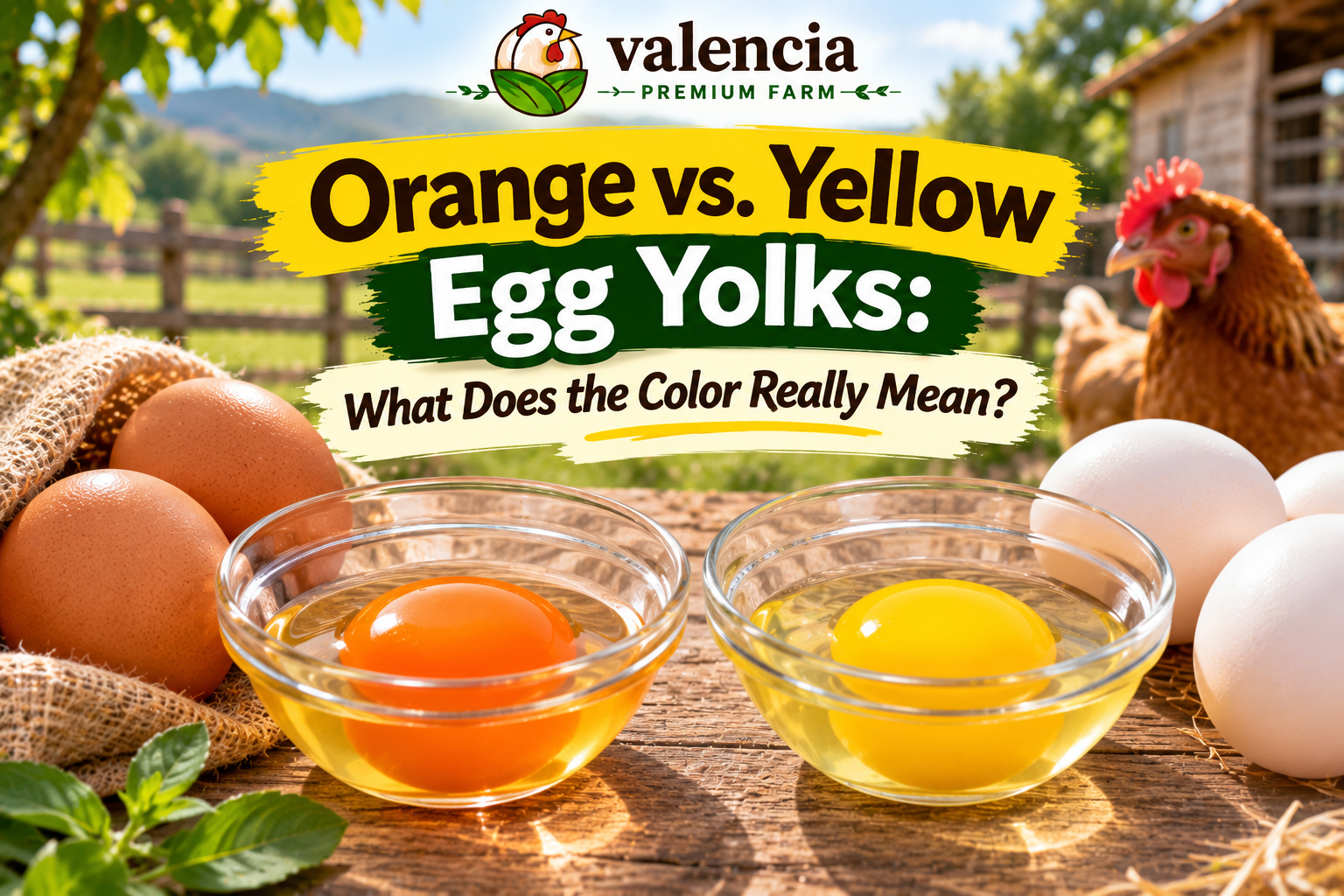
Have you ever cracked open an egg and noticed that its yolk was a deep orange instead of the familiar bright yellow? If so, you may have wondered whether the darker yolk was healthier, fresher, or simply better quality.
The debate surrounding orange vs. yellow egg yolks is common among people who buy farm-fresh eggs, shop at grocery stores, or pay attention to the food they eat.
Some people associate rich orange yolks with healthy, naturally raised chickens. Others believe that yellow yolks are normal and that the difference is mostly cosmetic.
But what does science actually tell us?
The truth is that egg yolk color is influenced primarily by what hens eat. While the color can provide clues about certain dietary pigments, it does not automatically reveal an egg’s freshness, safety, protein content, or overall nutritional value.
In this guide, we’ll explore what causes different yolk colors, whether orange yolks are more nutritious, and what consumers should know when choosing eggs.
What Determines the Color of an Egg Yolk?
The color of an egg yolk is largely determined by pigments called carotenoids, which are naturally present in many plants and feed ingredients.
When hens consume foods containing these pigments, some of the compounds are absorbed and deposited into their developing egg yolks.
Depending on the types and amounts of pigments in their diets, yolks may appear pale yellow, golden yellow, or deep orange.
The Role of Carotenoids
Carotenoids are a group of naturally occurring pigments responsible for many yellow, orange, and red colors found in plants.
Common examples include:
- Lutein
- Zeaxanthin
- Beta-carotene
- Other yellow and red carotenoid pigments
Lutein and zeaxanthin are particularly relevant to egg yolks because they can accumulate in the yolk after being consumed by hens.
These compounds are also found in foods such as leafy greens and certain vegetables.
However, the amount deposited into an egg depends on the hen’s diet and other biological factors.
Why Some Yolks Are Yellow
Yellow yolks are common in eggs produced by hens consuming diets containing yellow-pigmented ingredients.
Corn, for example, can contribute yellow pigments to egg yolks.
The intensity of the color depends on the specific feed formulation and the amount of pigment available.
A lighter yellow yolk does not necessarily mean the hen was unhealthy or poorly cared for.
It simply indicates that the yolk contains a different concentration or combination of pigments.
Why Some Yolks Are Orange
Deep orange yolks typically result from diets containing greater amounts or different combinations of carotenoid pigments.
Certain feed ingredients can increase orange pigmentation.
Examples may include:
- Marigold-derived pigments
- Alfalfa
- Pigment-rich plant ingredients
- Certain carotenoid-rich vegetables
- Formulated poultry feed containing approved pigment sources
The resulting color can vary considerably.
An orange yolk is not necessarily evidence that a hen spent time outdoors, ate insects, or lived on pasture.
Both commercial and small-farm feeding programs can produce richly colored yolks.
Orange vs. Yellow Egg Yolks: Are Orange Yolks Healthier?
This is one of the most frequently asked questions about egg yolk color.
The short answer is: not necessarily.
A deeper orange color may reflect a higher concentration of certain carotenoid pigments, but it does not automatically mean the egg is healthier in every nutritional category.
Do Orange Yolks Have More Vitamins?
Some studies have found relationships between hen diets, yolk pigmentation, and concentrations of particular nutrients or carotenoids.
However, the color of the yolk alone cannot tell you exactly how much vitamin A, vitamin D, vitamin E, or other nutrients an egg contains.
Nutritional composition depends on several factors, including:
- The hen’s complete diet
- Feed formulation
- Nutrient supplementation
- Breed and individual variation
- Egg production and management conditions
A darker yolk may contain more of certain pigments without necessarily having more of every essential nutrient.
Do Orange Yolks Have More Protein?
No reliable conclusion about protein content can be made from yolk color alone.
Egg protein is found in both the white and yolk.
A large egg generally provides approximately six grams of protein, although the exact amount depends on its size.
Whether the yolk is pale yellow or deep orange does not establish that the egg contains significantly more protein.
For consumers looking to increase protein intake, egg size and total consumption are more relevant considerations than yolk color.
Are Orange Yolks Better for Eye Health?
Lutein and zeaxanthin are carotenoids associated with eye health because they are components of the macular pigment in the human retina.
Egg yolks can provide these compounds.
However, an orange appearance does not provide a precise measurement of lutein or zeaxanthin content.
Different pigments contribute to color in different ways.
Therefore, it would be inaccurate to claim that every orange yolk is better for eye health than every yellow yolk.
Does Chicken Feed Affect Egg Yolk Color?
Yes. Chicken feed is one of the most important factors influencing egg yolk pigmentation.
Hens obtain the nutrients and pigments needed for egg production through their diets.
The ingredients they consume influence several characteristics of the eggs they produce.
Corn and Yellow Yolks
Corn is a common ingredient in poultry feed.
Yellow corn contains carotenoid pigments that can contribute to golden or yellow yolks.
However, corn alone does not determine the final color.
A hen’s complete diet matters more than any single ingredient.
Greens and Natural Plant Pigments
Leafy plants and certain green feed ingredients contain carotenoids.
When included in a hen’s diet, they may contribute to yolk pigmentation.
The effect depends on the specific plants, their pigment concentrations, the quantities consumed, and how efficiently the hen absorbs those pigments.
Marigold and Orange Pigmentation
Marigold-derived ingredients are sometimes used in poultry nutrition because they contain carotenoid pigments.
These ingredients can help produce more intensely colored yolks.
This is an important example of why yolk color should not be used as a direct indicator of how a hen was raised.
A rich orange color can result from a carefully formulated diet rather than outdoor access.
What About Non-GMO Feed?
Some consumers assume that eggs from hens fed non-GMO feed must have darker yolks.
However, non-GMO feed does not guarantee a particular yolk color.
The term refers to characteristics of the feed ingredients, not the amount of yellow or orange pigment they contain.
A non-GMO feeding program may produce yellow or orange yolks depending on its nutritional composition.
At Valencia Premium Farm in Acton, California, our cage-free hens receive non-GMO feed.
We believe customers should understand that feed practices and yolk pigmentation are related but separate considerations.
Does Egg Yolk Color Tell You How Chickens Were Raised?
Yolk color is sometimes used as a visual shortcut for judging animal welfare.
However, this can lead to incorrect assumptions.
A dark orange yolk does not automatically mean a chicken was pasture-raised, free-range, or raised under superior welfare conditions.
Cage-Free Hens
Cage-free hens are not housed in conventional cages and can move within their housing environment.
Their egg yolks may vary in color depending on what they eat.
Cage-free does not automatically mean the hens have outdoor access.
Free-Range Hens
Free-range systems include outdoor-access requirements under applicable labeling standards.
Outdoor access may expose hens to additional foods, but it does not guarantee a particular yolk color.
Their regular feed remains an important influence.
Pasture-Raised Hens
Pasture-raised hens may consume vegetation and other foods available in their environment.
These dietary differences can influence yolk pigmentation.
However, pasture access alone does not establish a specific color or nutrient concentration.
Organic Eggs
Organic eggs must meet applicable organic production requirements.
Those standards concern more than yolk color.
An organic egg can have a yellow or orange yolk.
Similarly, a dark orange yolk does not prove that an egg is certified organic.
The best way to evaluate farming practices is to ask the producer and review reliable certification or labeling information rather than relying on yolk appearance.
Are Dark Orange Egg Yolks Fresher?
Another popular belief is that orange yolks indicate fresher eggs.
This is a misconception.
Yolk color is primarily related to diet, while freshness depends on factors such as collection date, storage conditions, and time since laying.
A recently laid egg may have a pale yellow yolk.
An older egg may retain an orange yolk.
The two characteristics are not reliable substitutes for each other.
How Can You Evaluate Egg Freshness?
Instead of judging freshness by color, consider:
- Collection or packing dates.
- Proper refrigeration.
- Eggshell condition.
- Storage history.
- The appearance and odor of the egg after cracking.
Fresh eggs often have thicker whites that remain more compact around the yolk.
As eggs age, their whites may become thinner.
However, appearance alone cannot confirm food safety.
Does a Firm Yolk Mean an Egg Is Fresh?
Yolk structure can change over time, but it is not a complete freshness or safety test.
A yolk that breaks easily may be affected by egg age, handling, or other factors.
The safest approach is to purchase eggs from a reliable source, store them properly, and follow food-safety recommendations.
Do Orange and Yellow Egg Yolks Taste Different?
Many people believe that eggs with orange yolks taste richer.
Taste preferences are subjective, and several factors can influence the eating experience.
These may include:
- The hen’s diet
- Egg freshness
- Cooking method
- Additional ingredients
- Individual expectations
Some feeding practices may influence the flavor characteristics of eggs.
However, yolk color alone is not a dependable way to predict taste.
Why Cooking Methods Matter
A softly cooked yolk has a different texture from a fully cooked yolk.
Butter, cooking oil, seasonings, and preparation techniques also affect flavor.
For example, an egg prepared with butter and served immediately may taste richer than one cooked without fat, regardless of yolk color.
The appearance of an orange yolk may also influence how people perceive the food before tasting it.
For this reason, visual preference and actual nutritional differences should be considered separately.
Orange vs. Yellow Egg Yolks: A Simple Comparison
| Feature | Orange Yolks | Yellow Yolks |
|---|---|---|
| Main color influence | Dietary carotenoid pigments | Dietary carotenoid pigments |
| Protein content | Not determined by color | Not determined by color |
| Freshness | Not determined by color | Not determined by color |
| Food safety | Depends on handling and cooking | Depends on handling and cooking |
| Farming method | Cannot be confirmed by color | Cannot be confirmed by color |
| Nutritional value | May vary with the complete diet | May vary with the complete diet |
| Flavor | Color alone is not a reliable predictor | Color alone is not a reliable predictor |
The most important takeaway is that neither yolk color should automatically be considered superior.
A better evaluation includes the complete product, the producer’s practices, nutritional information, and proper food handling.
Can Egg Yolk Color Change Throughout the Year?
Yes. Yolk color can change when a hen’s diet changes.
This may occur when farms adjust feed formulations or when hens consume different ingredients over time.
Seasonal conditions can also influence feed availability in certain farming systems.
Seasonal Feed Changes
Some producers use feed ingredients that vary according to availability or nutritional needs.
If the concentration of carotenoids changes, yolk pigmentation may also change.
Natural Variation Between Hens
Even when hens receive similar diets, their eggs may not look exactly alike.
Individual biological differences can affect pigment absorption and deposition.
This means that minor variations in yolk color are not necessarily unusual.
Is Consistent Yolk Color Important?
Consistency may be desirable for commercial presentation, but uniform color does not automatically establish superior nutrition or quality.
Consumers should avoid interpreting every difference in yolk color as a problem.
If an egg has an unusual odor, abnormal appearance, or signs of spoilage, it should not be consumed.
What Really Matters When Choosing Quality Eggs?
Rather than selecting eggs based entirely on yolk color, consider several practical factors.
1. Proper Egg Handling
Eggs should be collected, handled, and stored according to applicable food-safety requirements.
Clean, intact shells and appropriate refrigeration are important.
2. Transparent Farming Practices
Knowing how hens are housed and fed can help customers make informed choices.
Terms such as cage-free, organic, and free-range have different meanings.
3. Reliable Product Information
Look for appropriate labeling, dates, and information about the producer.
Ask questions when something is unclear.
4. Nutritional Needs
Eggs provide protein and several essential nutrients.
Consumers with specific nutritional requirements should evaluate the overall nutrient profile rather than relying on appearance.
5. Supporting Local Producers
Buying directly from a nearby farm allows customers to connect with the people producing their food.
It can also provide opportunities to ask questions about handling, availability, and ordering.
Farm-Fresh Eggs in Santa Clarita Valley
For residents of Santa Clarita Valley, finding a local egg producer can be a practical way to learn more about where their food comes from.
Valencia Premium Farm is located in Acton, California, and serves customers seeking locally raised eggs.
Our hens are cage-free and fed non-GMO feed.
We encourage customers to focus on the complete farming and food-handling process rather than judging eggs only by yolk color.
Egg Options at Valencia Premium Farm
We offer two convenient purchasing options:
12 eggs — $7
A practical quantity for smaller households or occasional egg consumption.
30 eggs — $15
An option for families, frequent home cooks, and customers who regularly use eggs for breakfast, baking, or meal preparation.
Pickup and Delivery
Customers can inquire about farm pickup in Acton.
Local delivery is also available in eligible areas of Santa Clarita Valley, subject to address confirmation.
For availability, ordering, or delivery questions, contact our customer service representative through WhatsApp:
+1 (661) 627-7030
Frequently Asked Questions About Egg Yolk Color
Why are some egg yolks orange and others yellow?
The difference is primarily caused by carotenoid pigments in the hens’ diets. Different feed ingredients and pigment concentrations can produce different yolk colors.
Are orange egg yolks healthier than yellow yolks?
Not automatically. Orange yolks may contain different amounts of certain carotenoids, but color alone does not establish superior overall nutrition.
Do darker yolks have more protein?
Yolk color is not a reliable indicator of protein content. Egg size and the overall composition of the egg are more relevant.
Do orange yolks mean the chickens are free-range?
No. Deep orange yolks can result from specific feed ingredients, regardless of whether hens have outdoor access.
Can cage-free eggs have yellow yolks?
Yes. Cage-free refers to how hens are housed, not the color of their egg yolks.
Are orange egg yolks fresher?
No. Yolk color does not reliably indicate freshness. Collection dates, handling, refrigeration, and storage are more useful considerations.
Are yellow egg yolks safe to eat?
Yes. Yellow yolks are normal. Egg safety depends on appropriate handling, refrigeration, and cooking, not whether the yolk is yellow or orange.
Does non-GMO chicken feed produce orange yolks?
Not necessarily. Non-GMO feed does not guarantee any particular yolk color. Pigmentation depends on the ingredients and their carotenoid content.
Final Thoughts: Does Egg Yolk Color Really Matter?
When comparing orange vs. yellow egg yolks, the most important fact to remember is that color primarily reflects pigments in a hen’s diet.
A deep orange yolk may look appealing, but it does not automatically mean the egg is fresher, safer, richer in protein, or produced under better farming conditions.
Yellow yolks can also be nutritious and perfectly normal.
Instead of judging eggs by color alone, focus on reliable producers, transparent feeding practices, proper refrigeration, and safe food preparation.
At Valencia Premium Farm, we believe understanding where your food comes from is an important part of making informed choices.
If you’re looking for locally raised eggs in Acton or Santa Clarita Valley, our team can help you explore available purchasing options.
Order Farm-Fresh Eggs from Valencia Premium Farm
🥚 12 eggs — $7
🥚 30 eggs — $15
📍 Farm pickup in Acton, California
🚗 Local delivery in eligible Santa Clarita Valley areas
📲 WhatsApp: +1 (661) 627-7030
Farm Fresh · Locally Raised · Always Delicious.