
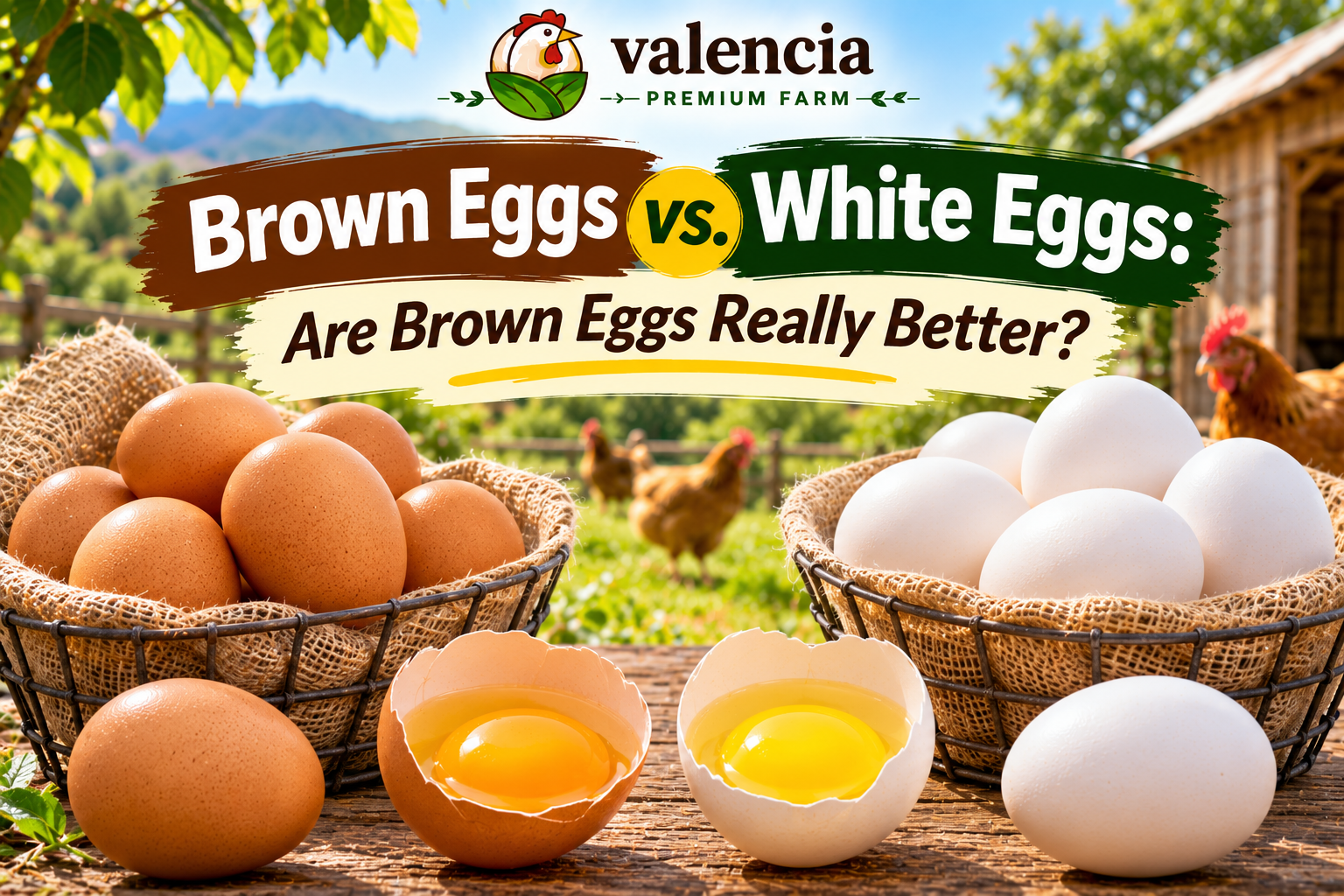
When shopping for eggs, you’ve probably noticed two common options: brown eggs and white eggs. While they may look different on the outside, many consumers wonder whether the color of the shell reveals something important about the egg inside.
Are brown eggs healthier? Do white eggs contain fewer nutrients? Are brown eggs more natural or fresher? And why do brown eggs sometimes cost more at the grocery store?
The discussion about brown eggs vs. white eggs has led to several misconceptions about egg quality, nutrition, and farming practices.
Some shoppers associate brown eggs with small farms, natural foods, and healthier chickens. Others choose white eggs because they are often more affordable and widely available.
But what does science actually tell us?
The answer is surprisingly simple: the color of an eggshell is primarily determined by the genetics of the hen that lays it.
Both brown and white eggs can provide excellent nutrition, and neither color automatically indicates superior freshness, taste, or quality.
In this guide, we’ll explore the differences between brown and white eggs, explain why chickens produce different shell colors, and help you understand what really matters when choosing eggs for your family.
Why Are Some Eggs Brown and Others White?
The main reason eggs have different shell colors is genetics.
Different chicken breeds naturally produce eggs with different shell colors.
Some breeds lay white eggs, while others produce brown, cream-colored, blue, or even greenish eggs.
The shell color develops during egg formation inside the hen’s reproductive system.
How Eggshell Color Develops
An eggshell forms primarily from calcium carbonate.
As the egg develops, pigments may be deposited onto or incorporated into the shell, depending on the hen’s genetics.
Brown eggs obtain much of their coloring from a pigment called protoporphyrin IX.
This pigment is deposited mainly in the outer layers of the eggshell during the final stages of egg formation.
White eggs generally have little or no brown pigment deposited on their shells.
The result is a visible difference in appearance, even though the eggs contain many of the same essential nutrients.
Chicken Breeds That Lay Brown Eggs
Several chicken breeds are known for producing brown eggs.
Examples include:
- Rhode Island Red
- Plymouth Rock
- Australorp
- Orpington
- Marans
The exact shade of brown can vary depending on the breed and individual hen.
Some hens lay light tan eggs, while others produce rich chocolate-brown shells.
Chicken Breeds That Lay White Eggs
White eggs are commonly produced by breeds such as:
- White Leghorn
- Ancona
- Minorca
White Leghorns are particularly common in commercial egg production because of their efficient egg-laying characteristics.
However, a chicken’s breed does not automatically determine how it is housed or cared for.
Both brown-egg and white-egg laying hens can be raised under different farming systems.
Brown Eggs vs. White Eggs: Nutritional Differences
One of the biggest myths about eggs is that brown eggs are more nutritious than white eggs.
In reality, shell color alone does not determine nutritional quality.
Both types of eggs naturally provide important nutrients.
These include:
- High-quality protein
- Vitamin B12
- Choline
- Selenium
- Riboflavin
- Phosphorus
Eggs also contain varying amounts of other vitamins, minerals, and fats.
Do Brown Eggs Have More Protein?
No. Brown eggs do not inherently contain more protein than white eggs.
Protein content depends primarily on the size and composition of the egg, not the shell color.
A typical large egg provides approximately six grams of protein.
A large brown egg and a large white egg will generally have similar protein content when other relevant factors are comparable.
Do Brown Eggs Have More Vitamins?
There is no reliable basis for assuming that brown eggs contain more vitamins simply because their shells are darker.
The nutritional composition of eggs can be influenced by factors such as:
- The hen’s diet
- Feed formulation
- Egg size
- Nutritional supplementation
- Individual biological variation
For example, hens fed specially formulated diets may produce eggs with different levels of certain nutrients.
These differences are related to feeding practices rather than shell pigmentation.
Are White Eggs Less Healthy?
No.
White eggs are not nutritionally inferior simply because they have white shells.
They can provide the same essential nutrients found in brown eggs.
For consumers, choosing eggs based on reliable nutritional information, proper handling, and personal preferences is more useful than choosing based on color alone.
Do Brown Eggs Taste Better Than White Eggs?
Another common belief is that brown eggs have a richer or more natural flavor.
However, eggshell color is not a dependable predictor of taste.
A brown egg does not automatically taste different from a white egg.
What Actually Affects Egg Flavor?
Several factors can influence how an egg tastes, including:
Chicken diet: The ingredients hens consume may influence certain flavor characteristics.
Egg storage: Storage conditions and time can affect egg quality.
Cooking method: Frying, boiling, scrambling, and baking create different flavors and textures.
Added ingredients: Butter, oils, herbs, seasonings, and other ingredients can significantly change the final taste.
Personal expectations can also influence how people perceive flavor.
Someone who associates brown eggs with farm-fresh products may expect a richer taste before trying them.
However, shell color itself does not establish a meaningful flavor advantage.
Can You Taste the Difference in a Blind Test?
When eggs are similar in size, freshness, handling, and feeding conditions, the shell color alone provides no reliable reason to expect a noticeable taste difference.
Consumers may still prefer one product over another, but that preference should not be attributed automatically to shell color.
Why Are Brown Eggs Sometimes More Expensive?
If brown and white eggs are nutritionally similar, why do brown eggs sometimes cost more?
The answer often involves production economics and market demand.
Differences in Chicken Breeds
Some breeds commonly used for brown egg production are larger or have different feed requirements than breeds commonly used for white egg production.
Feed is a major expense in egg farming.
When a flock requires more feed to produce a comparable number of eggs, production costs may increase.
However, the actual cost depends on the breed, management practices, feed prices, and production efficiency.
Not every brown-egg operation is more expensive than every white-egg operation.
Consumer Demand and Marketing
Brown eggs are sometimes marketed as natural, premium, or farm-style products.
These associations may influence consumer preferences and retail pricing.
However, a higher price does not automatically mean the eggs are healthier or fresher.
Farming Practices and Certifications
Some egg products cost more because of production requirements, certifications, packaging, or distribution arrangements.
For example, cage-free and certified organic production may involve different costs.
These factors should be evaluated independently of shell color.
A brown egg is not automatically organic, cage-free, or pasture-raised.
Likewise, a white egg can come from hens raised under those systems.
Are Brown Eggs More Natural Than White Eggs?
Both brown and white eggs are naturally produced by chickens.
Their colors result from normal biological processes.
A white eggshell is not necessarily bleached or artificially processed to become white.
Similarly, a brown eggshell does not automatically indicate a more natural production process.
Are White Eggs Bleached?
A common misconception is that white eggs are brown eggs that have been chemically bleached.
This is false.
Hens that naturally lay white eggs produce shells with little or no brown pigmentation.
Commercial egg handling may involve cleaning and sanitizing procedures, but those processes do not explain why white-egg laying breeds produce white shells.
Are Brown Eggs Organic?
Not necessarily.
Organic certification involves specific agricultural production standards.
The USDA organic program addresses requirements involving feed, management, and other aspects of production.
Eggshell color is not proof of organic certification.
Consumers should look for valid organic labeling rather than relying on the appearance of the egg.
Does Eggshell Color Tell You How Chickens Are Raised?
No. Eggshell color and housing practices are separate characteristics.
A chicken’s genetics largely determine the color of its eggs, while farming practices determine how the animal is managed.
Cage-Free Eggs
Cage-free hens are not housed in conventional cages and can move within their housing environment.
They may produce brown or white eggs depending on their breed.
Cage-free does not necessarily mean the hens have outdoor access.
Free-Range Eggs
Free-range production involves outdoor-access requirements under applicable standards.
Free-range hens can lay eggs of different colors.
Pasture-Raised Eggs
Pasture-raised hens may have access to vegetation and other outdoor resources.
However, access to pasture does not determine whether their eggs will have brown or white shells.
Non-GMO Feed
Some farms use non-GMO feed as part of their feeding practices.
Non-GMO feed does not determine shell color.
At Valencia Premium Farm in Acton, California, our hens are cage-free and fed non-GMO feed.
These farming characteristics are separate from the natural shell colors produced by different chicken breeds.
Are Brown Eggs Fresher Than White Eggs?
No. The color of an eggshell is not an indicator of freshness.
A brown egg can be recently laid or several weeks old.
The same is true for a white egg.
Freshness depends on factors such as:
- Collection date
- Packing date
- Storage temperature
- Handling conditions
- Time since the egg was laid
How to Check Egg Freshness
Instead of judging eggs by shell color, consumers should consider the available dates and storage information.
When cracking an egg, a fresher egg often has a thick white that remains relatively compact around the yolk.
As an egg ages, the white naturally becomes thinner.
However, this visual characteristic does not establish that an egg is free from harmful bacteria.
Proper refrigeration and safe cooking remain essential.
Does the Float Test Prove an Egg Is Safe?
The popular egg float test is sometimes used to estimate egg age.
As an egg ages, its air cell generally becomes larger, making it more buoyant.
However, floating does not reliably determine whether an egg is safe to eat.
Foodborne pathogens cannot be identified through this test.
Consumers should follow appropriate food-safety recommendations rather than relying on floating behavior alone.
Brown Eggs vs. White Eggs: Does Shell Thickness Matter?
Some consumers believe brown eggs have stronger or thicker shells than white eggs.
However, shell thickness is not determined simply by color.
Several factors influence eggshell quality.
Hen Age
As laying hens age, changes in egg size and shell formation can affect shell strength.
Calcium Intake
Calcium is essential for eggshell formation.
Hens require an appropriately balanced diet to support normal egg production.
Nutrition and Management
Overall nutrition, environmental conditions, flock health, and individual differences can influence shell quality.
A brown shell is not automatically stronger than a white shell.
Both types of eggs should be handled carefully to avoid cracks.
What About the Color of the Egg Yolk?
Shell color and yolk color are two different characteristics.
A brown egg can contain a pale yellow yolk.
A white egg can contain a deep orange yolk.
The color of the shell is primarily determined by genetics, while yolk pigmentation is influenced largely by the hen’s diet.
Does a Brown Shell Mean an Orange Yolk?
No.
A dark shell does not guarantee a dark yolk.
Likewise, a white shell does not mean the yolk will be pale.
The pigments responsible for eggshell color differ from the carotenoids that influence yolk pigmentation.
Are Orange Yolks Healthier?
Not automatically.
A deeper orange yolk may reflect different concentrations of dietary carotenoid pigments.
However, yolk color alone does not establish superior overall nutritional quality.
For a more detailed explanation, read our related article:
Orange vs. Yellow Egg Yolks: What Does the Color Really Mean?
Brown Eggs vs. White Eggs: Comparison Chart
| Characteristic | Brown Eggs | White Eggs |
|---|---|---|
| Shell color | Brown or tan | White |
| Main cause of color | Hen genetics and shell pigments | Hen genetics and little or no brown pigment |
| Protein content | Depends on egg size and composition | Depends on egg size and composition |
| Nutritional value | Not inherently superior | Not inherently inferior |
| Taste | Not determined by shell color | Not determined by shell color |
| Freshness | Depends on collection and storage | Depends on collection and storage |
| Shell strength | Depends on several biological factors | Depends on several biological factors |
| Farming method | Cannot be determined by color | Cannot be determined by color |
| Price | May be higher in some markets | May be lower in some markets |
The comparison shows that shell color is primarily a visual characteristic rather than a reliable measure of quality.
How to Choose the Best Eggs for Your Family
When buying eggs, several factors deserve more attention than shell color.
1. Choose Eggs from a Reliable Source
Whether purchasing from a grocery store or local farm, choose a producer or retailer that follows appropriate handling and food-safety practices.
2. Inspect the Eggshells
Avoid purchasing eggs with cracked shells.
Cracks can allow bacteria to enter the egg.
3. Check Storage Conditions
Purchase eggs that have been stored according to applicable food-safety requirements.
At home, refrigerate shell eggs promptly at 40°F (4°C) or below.
4. Understand Egg Labels
Terms such as cage-free, free-range, and organic describe different production characteristics.
They should not be confused with shell color.
5. Consider Quantity and Price
Choose an egg quantity that matches your household’s needs.
A smaller carton may be convenient for occasional use, while larger flats can offer better value for frequent cooking.
6. Learn About the Producer
Buying directly from a local farm provides an opportunity to ask questions about how hens are raised and fed.
This can help you make decisions based on transparent information rather than assumptions about appearance.
Buying Farm-Fresh Eggs in Santa Clarita Valley
For households in Santa Clarita Valley and nearby communities, buying eggs directly from a local farm can provide an opportunity to connect with the producer.
Valencia Premium Farm is located in Acton, California.
Our farm raises cage-free hens fed non-GMO feed and offers eggs for customers seeking a local purchasing option.
Available Egg Quantities
We offer:
12 eggs — $7
A convenient option for individuals, couples, and smaller households.
30 eggs — $15
An option for larger families, frequent home cooks, and customers who regularly prepare meals with eggs.
At these prices, the 30-count flat offers a lower cost per egg.
Farm Pickup in Acton
Customers can arrange pickup at our farm in Acton.
Please contact us before visiting to confirm availability and pickup arrangements.
Local Delivery in Santa Clarita Valley
Valencia Premium Farm also offers local delivery to eligible addresses in Santa Clarita Valley.
Customers in Valencia, Newhall, Saugus, Canyon Country, and surrounding communities can contact us to confirm delivery coverage.
Availability depends on the specific ZIP code or delivery address.
For assistance with ordering, contact our customer service representative through WhatsApp:
+1 (661) 627-7030
Frequently Asked Questions About Brown and White Eggs
Are brown eggs healthier than white eggs?
No. Brown eggs are not inherently healthier than white eggs. Both provide important nutrients, and their nutritional composition depends on factors such as egg size and the hen’s diet.
Why do brown eggs cost more?
Brown eggs may cost more because of differences in production expenses, chicken breeds, market demand, packaging, or farming practices. The higher price does not automatically indicate better nutritional quality.
Do brown eggs taste better?
Not necessarily. Shell color is not a reliable predictor of flavor. Diet, storage, preparation, and personal preferences can influence how eggs taste.
Are white eggs bleached?
No. White eggs are naturally produced by certain chicken breeds. Their shells are not white because brown eggs have been bleached.
Are brown eggs always cage-free?
No. Eggshell color does not indicate whether hens are cage-free, free-range, or pasture-raised.
Do brown eggs have darker yolks?
Not necessarily. Yolk color depends largely on pigments in the hen’s diet, while shell color is primarily genetic.
Are brown eggs fresher than white eggs?
No. Freshness depends on collection, handling, refrigeration, and storage, not shell color.
Which eggs are better for baking?
Both brown and white eggs can be used for baking. Egg size, freshness, and recipe requirements matter more than shell color.
Can white eggs be organic?
Yes. White eggs can be certified organic when they meet the applicable organic production requirements.
Where can I buy farm-fresh eggs near Santa Clarita?
Valencia Premium Farm in Acton, California, offers eggs for farm pickup and local delivery inquiries in eligible Santa Clarita Valley areas.
Final Thoughts: Brown Eggs or White Eggs?
When comparing brown eggs vs. white eggs, the most important takeaway is that shell color does not determine overall quality.
Brown eggs are not automatically healthier, fresher, tastier, or more natural than white eggs.
Both types can provide high-quality protein and essential nutrients.
Instead of choosing eggs based solely on appearance, consider how they are handled, how the hens are raised and fed, and whether the product meets your family’s needs.
Understanding these differences can help you shop with confidence and avoid common misconceptions.
At Valencia Premium Farm, we believe that informed food choices begin with understanding where your food comes from.
Looking for Farm-Fresh Eggs in Santa Clarita Valley?
🥚 12 eggs — $7
🥚 30 eggs — $15
📍 Farm pickup available in Acton, California
🚗 Local delivery in eligible Santa Clarita Valley areas
📲 WhatsApp: +1 (661) 627-7030
Farm Fresh · Locally Raised · Always Delicious.