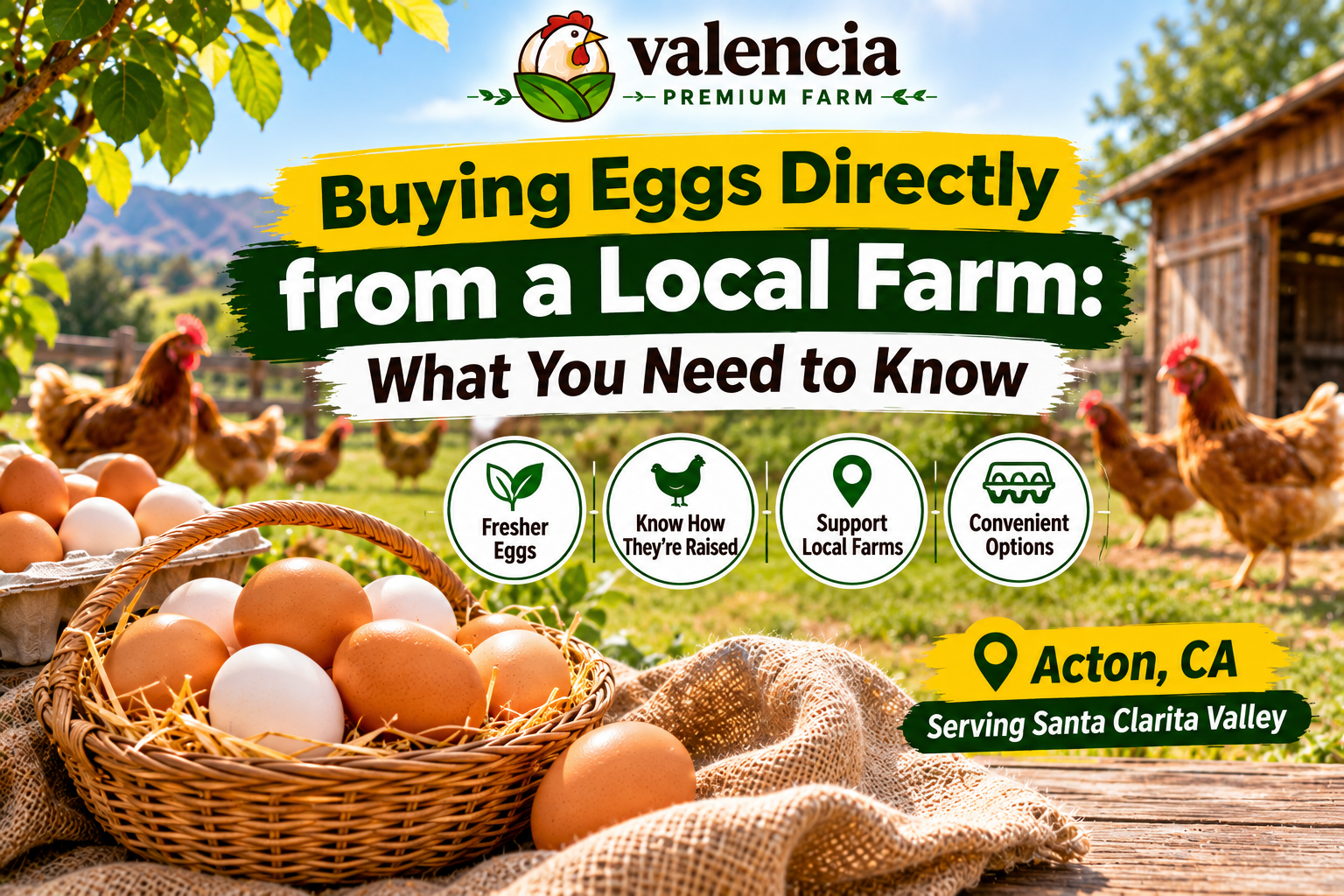
Buying eggs directly from a local farm is becoming an appealing option for families who want to know more about where their food comes from. Instead of choosing a carton from a crowded supermarket shelf, you can connect with a local producer, ask questions about farming practices, and find eggs that fit your household’s needs.
For residents of Santa Clarita Valley, Acton, and the greater Los Angeles area, buying locally can also mean supporting nearby agricultural businesses and discovering convenient options for farm pickup or local delivery.
However, before buying eggs directly from a local farm, it’s important to understand how freshness, egg quality, labeling, refrigeration, and pricing work.
This guide explains what to look for, which questions to ask, and how to make an informed purchase.
Why Buy Eggs Directly from a Local Farm?
Buying eggs locally offers an experience that is different from shopping at a traditional grocery store.
While supermarkets provide convenience and a wide variety of products, local farms can offer something particularly valuable: a direct connection between the person producing your food and the person purchasing it.
1. Know Where Your Eggs Come From
One of the biggest advantages of purchasing directly from a farm is transparency.
When you buy eggs from a local producer, you have an opportunity to learn more about:
- Where the chickens are raised.
- How the hens are housed.
- What type of feed they receive.
- How eggs are collected and handled.
- How to arrange pickup or delivery.
This information helps you make purchasing decisions based on more than packaging or advertising claims.
For example, Valencia Premium Farm, located in Acton, California, raises cage-free hens and uses non-GMO feed.
Understanding these details allows customers to choose products that align with their preferences.
2. Support Local Agriculture
Local farms are part of the agricultural communities surrounding Southern California.
When customers purchase directly from these businesses, they support local producers and the people responsible for caring for animals, maintaining farm operations, and preparing products for sale.
Supporting local agriculture can also help maintain connections between urban communities and nearby farming areas.
For residents of Santa Clarita, Valencia, Canyon Country, Newhall, Saugus, and Acton, buying from a nearby farm is one way to participate in the local food economy.
3. Ask Questions Before Purchasing
Another benefit of buying directly from a farm is the opportunity to communicate with the producer.
Instead of relying entirely on the information printed on an egg carton, customers can ask questions about availability, handling, storage, and purchasing options.
This is especially helpful when ordering eggs for a large family, preparing meals for an event, or purchasing larger quantities for regular use.
Are Farm-Fresh Eggs Actually Fresher?
The phrase “farm-fresh eggs” often creates an image of eggs collected that very morning.
However, freshness should not be determined by marketing language alone.
The actual freshness of an egg depends on several factors, including when it was laid, how it was handled, when it was packed, and how it was stored.
Understanding Egg Collection and Packing Dates
A local farm may have a shorter distribution process than a large commercial supplier, but this does not automatically mean every farm egg is fresher than every supermarket egg.
The best approach is to ask about collection dates and examine the available packaging information.
In California, egg labeling rules include requirements related to packing dates, sell-by dates, identification, grade, and size, subject to applicable exemptions.
The packing date may be expressed as a Julian date, which represents the day of the year on which the eggs were packed.
For example:
- 001 represents January 1.
- 032 represents February 1 in a non-leap year.
- 365 represents December 31 in a non-leap year.
Understanding these dates can help you compare eggs more accurately.
Does Freshness Affect Cooking?
Freshness can influence certain characteristics of an egg.
When a fresh egg is cracked onto a flat surface, its thick egg white often holds together more closely around the yolk.
As eggs age, the egg white naturally becomes thinner.
Fresh eggs may be particularly appealing for fried eggs or poached eggs, where appearance and structure matter.
However, properly refrigerated eggs can remain suitable for many different recipes over time.
Important: A fresh appearance does not guarantee that an egg is free from harmful bacteria. Safe storage and thorough cooking remain essential.
What Should You Look for When Buying Farm Eggs?
Not all farms operate in exactly the same way, so knowing what to check can make the purchasing experience easier.
Clean, Uncracked Eggshells
Eggshells provide a protective barrier around the contents of an egg.
Before purchasing, inspect the eggs when possible.
Look for shells that are intact and free from visible cracks.
According to the USDA, consumers should avoid purchasing cracked eggs because bacteria can enter through damaged shells.
Eggs should also be appropriately handled and stored.
A cracked egg should not be considered safe simply because it came from a local farm.
Proper Refrigeration
Refrigeration is an important part of egg safety.
California establishes requirements for egg handling and temperature control, with certain exceptions for qualifying direct-marketing activities.
For consumers, a practical recommendation is to keep purchased eggs refrigerated at 40°F (4°C) or below once they arrive home.
Avoid leaving eggs in a hot vehicle while running errands, particularly during Southern California’s warmer months.
Clear Product Information
A reliable purchasing experience should include clear information about what you are buying.
Depending on the applicable labeling rules, this can include the egg count, size, grade, producer identification, and relevant dates.
If any information is unclear, ask the farm before purchasing.
Cage-Free Eggs: What Does the Label Mean?
Egg labels can be confusing, especially when several different farming terms appear together.
One of the most common terms is cage-free.
Cage-free eggs come from hens that are not housed in conventional cages and can move within their housing environment.
However, cage-free does not necessarily mean the hens spend time outdoors.
This distinction is important because consumers sometimes confuse cage-free, free-range, pasture-raised, and organic eggs.
Cage-Free vs. Free-Range
Cage-free systems allow hens to move within their housing environment rather than remain in conventional cages.
Free-range production involves additional requirements related to outdoor access.
The terms are not interchangeable.
Cage-Free vs. Organic
Organic certification involves specific production standards, including feed and management requirements.
A farm using non-GMO feed is not automatically certified organic.
Similarly, a cage-free housing system does not establish that the eggs are organic.
At Valencia Premium Farm, our hens are cage-free and fed non-GMO feed. We encourage customers to understand the differences between these terms when choosing eggs.
Related reading: Cage-Free vs. Organic Eggs: Understanding Egg Labels in California
Are Local Farm Eggs More Nutritious?
Some consumers assume that eggs from a small local farm always contain more nutrients than supermarket eggs.
The reality is more complicated.
Eggs are naturally a source of protein and several important nutrients, including vitamin B12, selenium, and choline.
However, their specific nutrient composition can vary depending on factors such as the hens’ diet.
A local origin alone does not establish superior nutritional quality.
Does Chicken Feed Matter?
The feed consumed by laying hens can influence certain characteristics of their eggs.
For example, specialized feeding programs can change the fatty-acid composition of eggs.
Diet can also influence yolk pigmentation.
However, these differences should not be confused with a general guarantee that one egg is healthier than another.
Does Yolk Color Indicate Better Nutrition?
Egg yolks can range from pale yellow to deep orange.
This variation is influenced largely by pigments in the hens’ diet.
A darker yolk does not automatically mean that an egg contains more protein, is safer, or is universally more nutritious.
The color alone is not enough to determine overall egg quality.
Understanding the relationship between feed and yolk color can help customers avoid misleading assumptions when shopping for eggs.
How Much Do Eggs Cost When Buying Directly from a Farm?
Price is another important consideration.
The cost of farm eggs can depend on location, flock management, feed expenses, labor, packaging, egg size, and transportation.
Some local farms charge more than conventional supermarket brands, while others offer competitive pricing, especially when customers purchase larger quantities.
The best comparison is not simply the price of a carton.
Customers should also consider egg count, size, convenience, and their household’s typical consumption.
Buying a Dozen Eggs
A dozen eggs is a convenient option for individuals, couples, or smaller households.
Twelve eggs may be sufficient for several breakfasts, baking projects, or meal preparations, depending on how frequently they are used.
At Valencia Premium Farm, a dozen eggs is offered for $7.
Buying 30 Eggs at Once
Larger households or customers who cook frequently may prefer a 30-count egg flat.
At Valencia Premium Farm, a 30-count flat is offered for $15.
Here is a simple comparison:
| Quantity | Price | Price Per Egg |
|---|---|---|
| 12 eggs | $7 | Approximately $0.58 |
| 30 eggs | $15 | $0.50 |
A 30-count purchase offers a lower price per egg at these listed prices.
However, the larger option is most practical when the customer expects to use the eggs while they remain in good condition.
Buying more than you need may lead to unnecessary food waste.
How to Store Farm-Fresh Eggs Safely at Home
Proper storage matters regardless of where eggs are purchased.
Even eggs that were recently collected need appropriate handling.
Refrigerate Eggs Promptly
The USDA recommends purchasing eggs from refrigerated storage and refrigerating them promptly after purchase.
Once home, place eggs in the refrigerator at 40°F or below.
Keep them in their original carton when possible.
The carton helps protect the eggs and preserves useful product information.
Avoid Temperature Fluctuations
Repeated temperature changes can affect storage conditions.
Rather than leaving eggs on a kitchen counter for extended periods, return them to the refrigerator promptly after use.
This is especially important in warmer environments.
How Long Can Eggs Last?
According to USDA food-storage guidance, raw shell eggs generally can be refrigerated for three to five weeks.
Actual usability depends on proper handling, storage, and the condition of the eggs.
Always follow relevant package dates and discard eggs that show signs of spoilage or damage.
For additional information, consult the USDA Food Safety and Inspection Service.
Cook Eggs Thoroughly
Freshness does not eliminate the possibility of foodborne illness.
The FDA recommends cooking eggs until both the yolk and white are firm.
For recipes that call for raw or undercooked eggs, use pasteurized eggs or pasteurized egg products.
This is particularly important for young children, older adults, pregnant people, and individuals with weakened immune systems.
Questions to Ask Before Buying Eggs from a Local Farm
Before placing your first order, consider asking the producer a few practical questions.
1. When Were the Eggs Collected or Packed?
This helps you understand the product’s freshness and plan your storage.
2. How Are the Hens Raised?
Ask whether the hens are cage-free, free-range, or raised under another housing system.
Avoid assuming that different terms mean the same thing.
3. What Are the Hens Fed?
If feed is important to your purchasing decision, ask whether the farm uses conventional, non-GMO, or certified organic feed.
4. How Are the Eggs Stored?
Ask about refrigeration and handling practices, especially if you are purchasing during hot weather.
5. What Quantities Are Available?
Some farms offer only standard cartons, while others provide larger egg flats.
Choose a quantity that matches your family’s cooking habits.
6. Is Pickup or Delivery Available?
Confirm the available ordering methods, pickup arrangements, delivery coverage, and any applicable delivery conditions.
These details can vary by location and availability.
Where Can You Buy Local Farm Eggs in Santa Clarita Valley?
Residents of Santa Clarita Valley have several ways to explore locally produced food.
Options may include farm-direct purchases, farmers’ markets, and local agricultural businesses.
For customers looking specifically for eggs from a nearby producer, Valencia Premium Farm offers a farm-direct option.
Valencia Premium Farm in Acton, California
Located in Acton, Valencia Premium Farm raises cage-free hens fed non-GMO feed.
Our farm serves customers looking for fresh eggs in the Santa Clarita Valley area.
Available egg quantities include:
- 12 eggs for $7
- 30 eggs for $15
Customers can arrange farm pickup in Acton or inquire about local delivery within Santa Clarita Valley.
Delivery availability should be confirmed for each customer’s ZIP code or address.
Farm Pickup in Acton
Farm pickup can be convenient for customers who prefer to collect their eggs directly.
Our farm is located at:
34717 Red Rover Mine Rd, Acton, CA 93510
Contact us before visiting to confirm availability and arrange pickup.
Local Egg Delivery in Santa Clarita Valley
For customers who prefer delivery, Valencia Premium Farm serves eligible locations within Santa Clarita Valley.
Coverage and delivery arrangements depend on the specific address.
Customers in areas such as Valencia, Saugus, Newhall, Canyon Country, and surrounding communities can contact us to confirm whether their ZIP code is within the delivery area.
To inquire about ordering, contact us through WhatsApp at +1 (661) 627-7030.
Is Buying Eggs Directly from a Farm Worth It?
For many households, buying eggs directly from a local farm can be a practical and rewarding choice.
The value goes beyond the egg itself.
Customers may appreciate knowing where their food comes from, communicating with a local producer, and supporting a nearby agricultural business.
At the same time, buying locally should never mean overlooking food safety, refrigeration, labeling, or proper storage.
A thoughtful purchase considers all these factors.
The best choice depends on your priorities, budget, location, and how frequently your household uses eggs.
Frequently Asked Questions About Buying Eggs from a Local Farm
Are farm-fresh eggs better than supermarket eggs?
Not necessarily in every respect. Farm eggs may offer a more direct connection to the producer, but freshness, nutrition, and safety depend on handling, storage, feed, and other factors. Both farm and supermarket eggs can be good choices.
Is it safe to buy eggs directly from a farm?
Yes, eggs purchased directly from a farm can be a safe option when they are properly handled and the producer follows applicable food-safety requirements. Consumers should look for intact shells, appropriate refrigeration, and clear product information.
Do farm-fresh eggs need refrigeration?
Yes. In California, consumers should refrigerate purchased shell eggs promptly and keep them at 40°F or below at home, even though certain direct-marketing operations may qualify for specific temperature-control exceptions before sale.
Are cage-free eggs the same as organic eggs?
No. Cage-free describes a housing system, while organic certification involves additional production requirements. Cage-free eggs are not automatically organic.
Can I buy eggs directly from a farm near Santa Clarita?
Yes. Valencia Premium Farm is located in Acton, California, and offers farm pickup as well as local delivery inquiries for eligible Santa Clarita Valley locations.
Is buying 30 eggs cheaper than buying individual dozens?
It can be. At Valencia Premium Farm’s listed prices, a 30-count flat costs $15, or $0.50 per egg, compared with approximately $0.58 per egg when purchasing a dozen for $7.
How do I order eggs from Valencia Premium Farm?
Contact Valencia Premium Farm through WhatsApp at +1 (661) 627-7030 to inquire about egg availability, pickup arrangements, and delivery coverage for your ZIP code.
Final Thoughts: Choose Fresh Eggs with Confidence
Buying eggs directly from a local farm is an opportunity to make more informed food choices while supporting nearby agriculture.
Whether you are purchasing a dozen eggs for weekend breakfasts or a larger flat for regular meal preparation, understanding freshness, safe handling, egg labels, and storage helps you shop with confidence.
For residents of Acton and Santa Clarita Valley, Valencia Premium Farm offers a local option for purchasing eggs from cage-free hens fed non-GMO feed.
Ready to order farm-fresh eggs?
🥚 12 eggs — $7
🥚 30 eggs — $15
📍 Farm pickup: Acton, California
🚗 Local delivery: Santa Clarita Valley (confirm coverage)
📲 WhatsApp: +1 (661) 627-7030
Farm Fresh · Locally Raised · Always Delicious.