When you walk through the egg aisle at a grocery store, the number of choices can be surprisingly overwhelming. Conventional eggs, cage-free eggs, free-range eggs, organic eggs, pasture-raised eggs—the labels seem endless.
One of the most common comparisons shoppers make is cage-free eggs vs. regular eggs.
What does cage-free actually mean? Are cage-free eggs healthier? Do they taste different? And does buying fresh eggs from a local farm make a difference?
Understanding these terms can help you make a more informed decision about the eggs you bring home.
At Valencia Premium Farm in Acton, California, we believe knowing where your food comes from matters. In this guide, we’ll explain the main differences between cage-free and conventional eggs, what these labels actually tell you, and why freshness and farming practices are also important factors when choosing eggs.
What Are Cage-Free Eggs?
The term cage-free eggs refers primarily to the housing conditions of the hens that produce them.
Cage-free hens are not kept in conventional battery cages. Instead, they can generally move around within an indoor housing environment and have access to areas where they can perform behaviors such as walking, perching, nesting, and spreading their wings.
This represents an important distinction from traditional caged egg-production systems.
However, there is one common misconception:
Cage-free does not necessarily mean that hens spend their time outdoors.
A cage-free hen may live primarily indoors.
This is why consumers should understand the differences among terms such as:
- Cage-free
- Free-range
- Pasture-raised
- Organic
Although these labels are sometimes used interchangeably in everyday conversation, they don’t necessarily describe the same production methods.
For many shoppers, choosing cage-free eggs is primarily about supporting a housing system that provides hens with greater freedom of movement than conventional cages.
What Are Regular Eggs?
When people refer to regular eggs, they are usually talking about conventional eggs commonly sold in supermarkets.
Historically, many conventional egg-production systems have used cages to house laying hens. These systems allow farms to produce large quantities of eggs efficiently and at relatively low cost.
Because conventional eggs are produced on a large scale, they are often among the least expensive options available at grocery stores.
From a nutritional standpoint, however, the word “regular” doesn’t tell you everything about the egg.
The nutritional composition of an egg can be influenced by several factors, including:
- The hen’s diet
- Breed
- Age
- Farming practices
- Storage
- Egg freshness
This means the difference between cage-free and conventional eggs isn’t as simple as saying one type is always nutritionally superior to the other.
Cage-Free Eggs vs. Regular Eggs: Key Differences
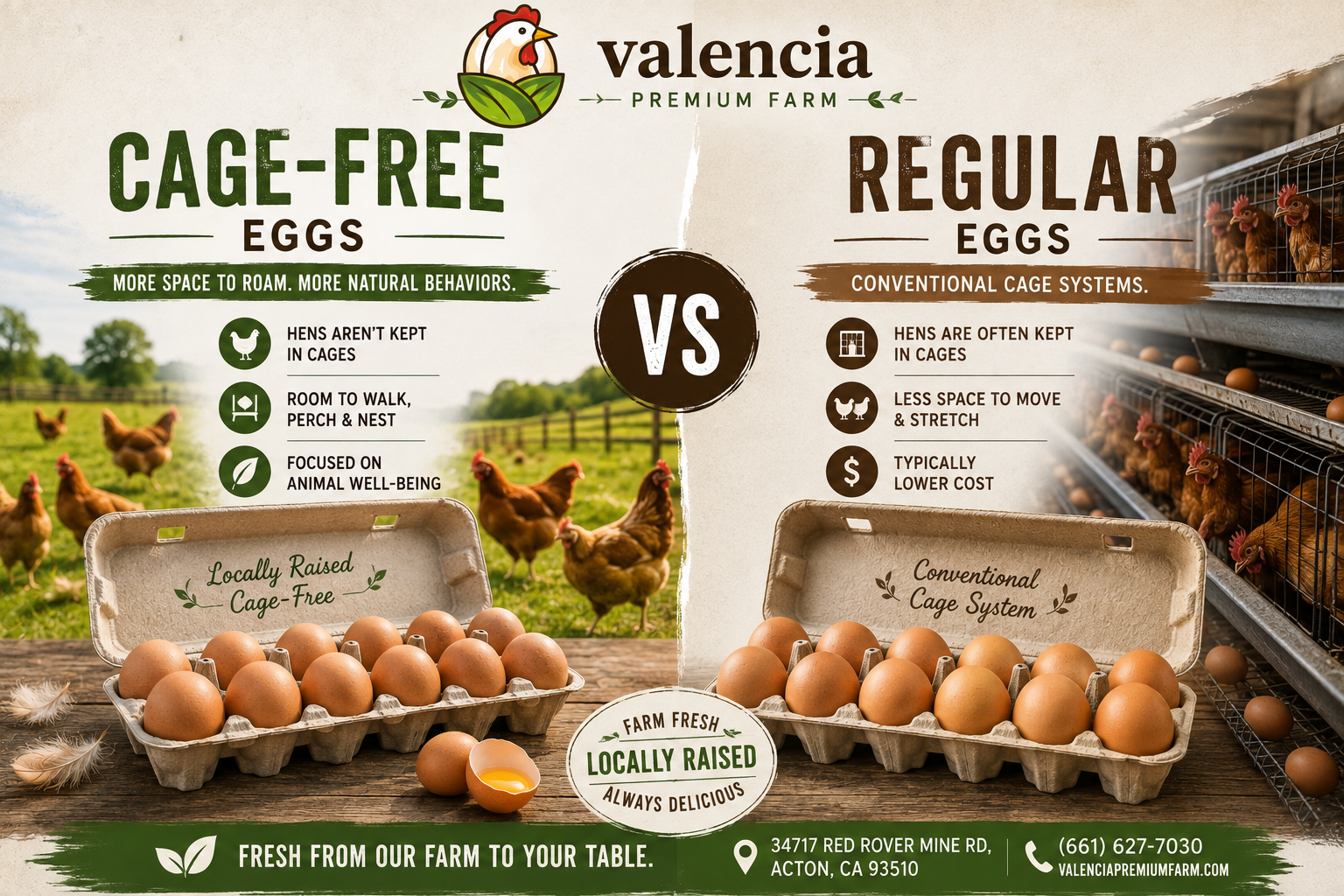
The biggest difference between cage-free eggs and regular eggs generally comes down to how the hens are housed.
Here’s a simplified comparison:
| Feature | Cage-Free Eggs | Conventional Eggs |
|---|---|---|
| Hens kept in traditional cages | No | May be |
| Freedom to move within housing | Greater | More restricted in caged systems |
| Outdoor access | Not necessarily | Not necessarily |
| Nesting/perching opportunities | Generally available | Depends on system |
| Price | Often higher | Usually lower |
| Nutritional value | Depends on multiple factors | Depends on multiple factors |
| Freshness | Depends on supply chain | Depends on supply chain |
One thing worth emphasizing is that cage-free describes a production system, not necessarily the freshness of the egg.
A cage-free egg can still travel through a large commercial distribution network before reaching a consumer.
That’s why shoppers interested in both animal care and freshness may also consider where their eggs are produced and how far they travel before reaching their kitchen.
Does Cage-Free Mean Free-Range?
No.
This is one of the most common sources of confusion when shopping for eggs.
Cage-free and free-range are not necessarily the same thing.
Cage-free hens are not confined to conventional cages and can generally move around within their housing environment.
Free-range systems typically involve some level of outdoor access in addition to indoor housing.
Then there is another category commonly seen on egg cartons: pasture-raised.
Pasture-raised systems generally emphasize outdoor access to pasture, although specific farming practices and certification requirements can vary.
The important point for consumers is that these terms describe different aspects of how hens are raised.
If animal housing is important to you, don’t rely only on attractive packaging. Look at the actual terminology being used and, whenever possible, learn more about the farm producing the eggs.
Are Cage-Free Eggs Healthier Than Regular Eggs?
This is probably the biggest question consumers have when comparing cage-free eggs vs. regular eggs.
The answer requires some nuance.
Simply being labeled cage-free does not automatically make an egg significantly more nutritious.
Eggs naturally contain several important nutrients, including:
- High-quality protein
- Vitamin B12
- Selenium
- Choline
- Riboflavin
- Fat-soluble nutrients found primarily in the yolk
However, the nutritional composition of eggs can vary depending on the hen’s diet and other production factors.
For example, eggs marketed as containing higher levels of omega-3 fatty acids usually come from hens fed a diet specifically designed to increase omega-3 content.
That difference comes from nutrition and farming practices, not simply whether the hen lived in a cage-free environment.
So if you’re choosing cage-free eggs, the primary distinction is generally related to hen housing and farming practices, rather than a guarantee of superior nutrition.
Do Cage-Free Eggs Taste Better?
Taste is subjective.
Some consumers strongly prefer eggs purchased directly from local farms and describe them as having richer yolks or a fresher flavor.
However, cage-free labeling alone does not guarantee a specific taste.
Several factors can influence how an egg tastes, including:
Freshness: Eggs consumed closer to when they were laid may provide a different culinary experience than eggs that have spent more time moving through storage and distribution.
Hen diet: What hens eat can influence characteristics of the eggs they produce.
Storage: Proper refrigeration and handling help preserve egg quality.
Cooking method: A fresh fried egg with a soft yolk provides a very different experience from the same egg used in baking.
This is why comparing a mass-market conventional egg with a locally produced cage-free egg involves more than simply comparing two labels.
You’re potentially comparing two different supply chains as well.
Freshness Matters More Than Many Shoppers Realize
When consumers search for the best eggs near Santa Clarita or Acton, they often focus on labels such as cage-free or organic.
But there’s another important factor:
How fresh are the eggs?
Large commercial food systems are designed to move enormous quantities of products across cities, states, and sometimes much greater distances.
Eggs may go through several stages between the farm and your refrigerator:
Farm → processing → distribution → warehouse → grocery store → consumer.
Buying directly from a local farm can shorten that journey.
Instead of wondering where your eggs originated, purchasing locally gives you an opportunity to know more about the producer and farming operation behind your food.
For residents of Acton, Santa Clarita and surrounding communities in Los Angeles County, this is one of the advantages of having local agricultural producers nearby.
Farm-Fresh Eggs vs. Grocery Store Eggs
The phrase farm-fresh eggs is often associated with eggs purchased directly from a farm or local producer.
But what makes the experience different?
One of the most obvious differences is the relationship between the consumer and producer.
When you purchase eggs at a large supermarket, it may be difficult to know much about the individual farm that produced them.
Buying directly from a local farm can make the supply chain much more transparent.
You can potentially learn:
- Where the hens are raised
- How the farm operates
- How the eggs are handled
- Where the farm is located
- Who produces your food
For consumers increasingly interested in local food, that transparency can be valuable.
Why Buy Local Cage-Free Eggs?
Choosing local cage-free eggs combines two purchasing considerations.
First, you’re choosing eggs produced without conventional cage confinement.
Second, you’re supporting a producer within your broader community.
There are several reasons consumers seek locally produced eggs.
Shorter Food Supply Chains
Local purchasing can reduce the number of steps between producer and consumer.
Connection to Your Food
Buying directly from a farm provides greater visibility into where your food originates.
Supporting Local Agriculture
Purchasing from nearby producers keeps more food spending connected to local agricultural businesses.
Freshness
A shorter route from farm to consumer can provide access to eggs closer to their production date.
For families in areas such as Acton and Santa Clarita, buying local eggs can therefore be about more than breakfast. It’s also a way to maintain a connection with agriculture in Southern California.
Cage-Free Eggs in California
California consumers are particularly familiar with conversations surrounding animal housing and egg-production standards.
Over the years, the state has implemented rules affecting how eggs sold in California are produced and how laying hens are housed.
As a result, terms related to animal welfare and production methods have become increasingly important to California shoppers.
But regulations don’t eliminate the need for consumers to understand food labels.
Knowing what terms such as cage-free, free-range, organic and pasture-raised mean can still help you choose products that better align with your preferences.
For shoppers who want even more information, purchasing directly from a local producer offers another advantage: you know exactly who to ask.
What Should You Look for When Buying Eggs?
Rather than choosing eggs based on a single word printed on the carton, consider several factors.
Farming Practices
How are the hens raised?
Understanding the farming system gives you more context than packaging alone.
Freshness
Consider how quickly the eggs move from the producer to the consumer.
Source
Look at where the eggs were produced.
If buying local is important to you, check whether the farm is actually located in your region.
Handling and Storage
Eggs need appropriate handling and refrigeration to maintain quality and food safety.
Your Priorities
Different consumers prioritize different things.
For one person, price may be the deciding factor. Another may prioritize local production. Someone else may focus primarily on animal housing practices.
There isn’t one universal answer for every household.
Where to Buy Cage-Free Farm Fresh Eggs Near Santa Clarita
If you’re searching online for terms such as:
“cage-free eggs near me”
“farm fresh eggs Santa Clarita”
“fresh eggs Acton CA”
or
“local eggs near Santa Clarita”
you may not need to rely exclusively on supermarket options.
Valencia Premium Farm is located in Acton, California, serving customers looking for locally raised, cage-free eggs in the surrounding area.
Our farm is located at:
Valencia Premium Farm
34717 Red Rover Mine Rd
Acton, CA 93510
Phone: (661) 627-7030
Located near the Santa Clarita Valley, our farm provides a local option for customers who want to know where their eggs come from.
Our approach centers around a simple idea:
Farm fresh. Locally raised. Always delicious.
Cage-Free vs. Free-Range vs. Pasture-Raised Eggs
Before buying eggs, it helps to understand the terminology.
Cage-Free
Hens are not housed in conventional cages and generally have room to move around within their housing environment.
Free-Range
Hens generally have some form of outdoor access in addition to indoor housing.
Pasture-Raised
Typically refers to systems where hens have more substantial access to outdoor pasture.
Organic
Organic certification involves requirements related to factors such as feed and production practices. Organic and cage-free are therefore not interchangeable terms.
These labels describe different aspects of egg production.
An egg can potentially belong to more than one category.
For example, an egg could be both organic and cage-free.
Are Brown Eggs Better Than White Eggs?
Another common misconception is that shell color determines egg quality.
It doesn’t.
Brown eggs and white eggs primarily differ because different breeds of chickens naturally produce different shell colors.
You may also encounter eggs in shades ranging from cream to blue or green depending on the breed.
Shell color alone does not tell you whether an egg is:
- More nutritious
- Fresher
- Cage-free
- Organic
- Better tasting
When choosing eggs, production practices and freshness provide far more useful information than shell color.
Why Do Some Egg Yolks Look More Orange?
You’ve probably cracked eggs and noticed that some yolks are pale yellow while others are deep golden or orange.
Yolk color is influenced largely by what hens eat.
Certain pigments naturally present in feed can create deeper-colored yolks.
However, a darker yolk should not automatically be interpreted as proof that an egg is healthier.
It’s another example of why judging egg quality based purely on appearance can be misleading.
Understanding the farm and production practices behind the egg gives you much more meaningful information.
Are Local Eggs Better?
“Better” depends on what matters to you.
If your priority is finding the lowest possible price, large-scale conventional eggs may be attractive.
If your priorities include knowing the producer, supporting local agriculture, reducing the distance between farm and table, and purchasing fresh eggs from a nearby source, local eggs may be a better fit.
Local farms also offer something supermarkets often cannot:
a direct connection between the person producing the food and the person eating it.
For many customers, that’s increasingly valuable.
Frequently Asked Questions About Cage-Free Eggs
Are cage-free eggs healthier than regular eggs?
Not necessarily. Cage-free primarily describes how hens are housed. Nutritional differences can depend on the hens’ diet and other farming factors.
Are cage-free eggs organic?
Not automatically.
Cage-free and organic describe different production requirements. Eggs may be cage-free without being certified organic.
Are cage-free eggs the same as free-range eggs?
No. Cage-free hens aren’t kept in conventional cages, but the label does not necessarily mean they have outdoor access.
Why are cage-free eggs more expensive?
Production costs can vary depending on housing systems, farm size, labor, feed, handling, distribution and other factors.
Do cage-free eggs taste different?
Cage-free housing alone doesn’t guarantee a particular flavor. Freshness, hen diet, handling and other factors can influence the eating experience.
Are brown eggs healthier than white eggs?
No. Shell color is primarily determined by chicken breed and does not inherently indicate nutritional superiority.
Where can I buy farm fresh eggs in Acton, CA?
Valencia Premium Farm is located at 34717 Red Rover Mine Rd, Acton, CA 93510. Customers can contact the farm at (661) 627-7030 for current purchasing information.
Can I find local farm fresh eggs near Santa Clarita?
Yes. Acton is located near the Santa Clarita Valley, making local farms in the surrounding region an option for customers looking beyond conventional supermarket eggs.
Cage-Free Eggs vs. Regular Eggs: Which Should You Choose?
So, after comparing cage-free eggs vs. regular eggs, which should you buy?
The answer depends on what you value.
Cage-free eggs provide an alternative to conventional cage-based housing systems by allowing hens greater freedom of movement within their environment.
But the cage-free label isn’t the entire story.
If you want to make a more informed choice, consider:
How were the hens raised?
Where were the eggs produced?
How fresh are they?
How transparent is the producer about its farming practices?
Are you interested in supporting a local farm?
These questions provide a much broader picture of the food you’re buying.
At Valencia Premium Farm, we’re proud to produce locally raised, cage-free eggs in Acton, California, for customers who value freshness, quality and knowing where their food comes from.
From our farm to your table.
Valencia Premium Farm
📍 34717 Red Rover Mine Rd, Acton, CA 93510
📞 (661) 627-7030
Farm fresh · Locally raised · Always delicious